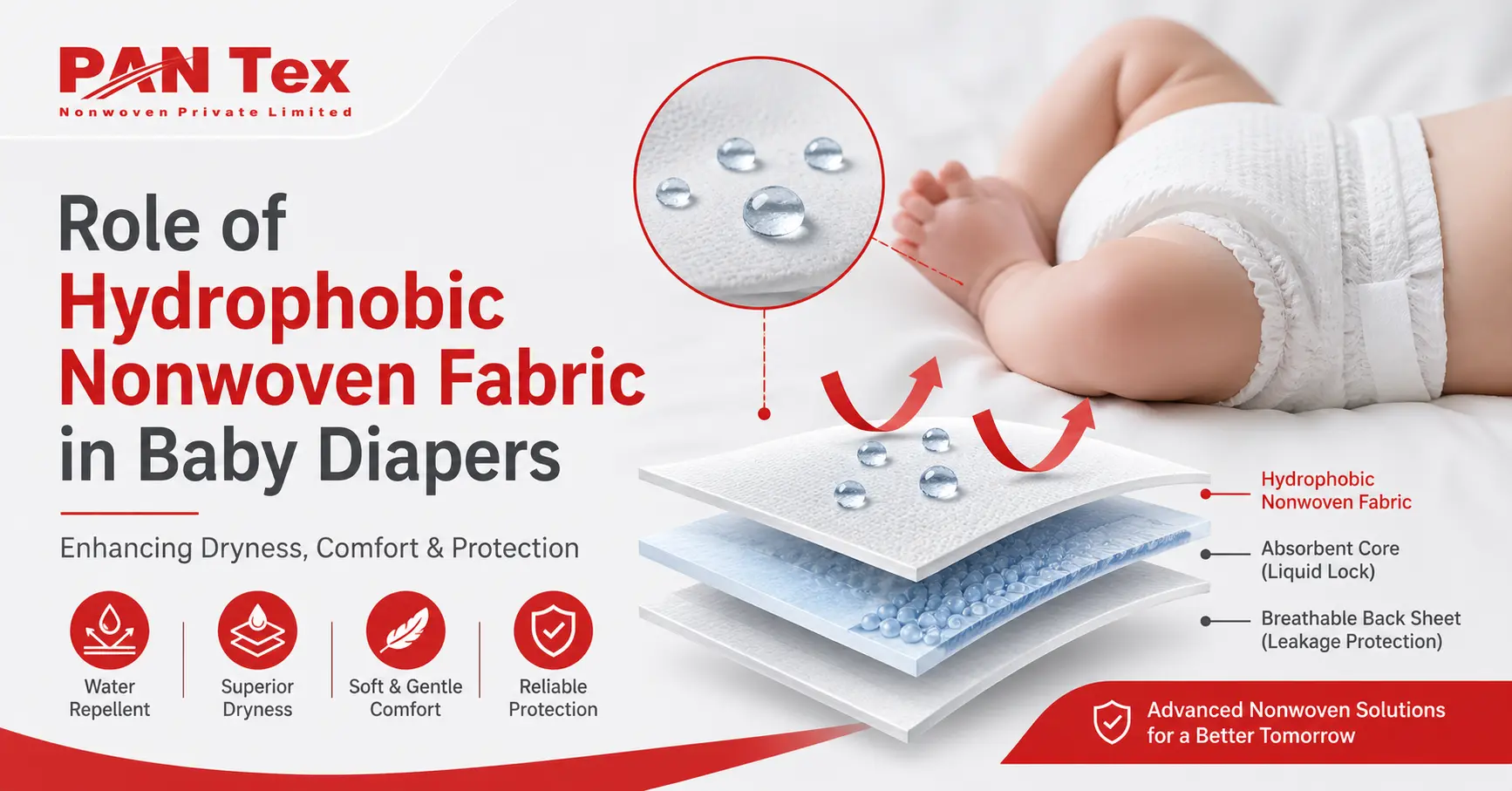
Baby diaper performance is determined by more than absorbent capacity alone. The specific fabric used at each layer position determines whether a baby’s skin stays dry, protected from leakage, and free from irritation throughout every wear period.
Two types of nonwoven fabric work together inside every modern baby diaper. Hydrophilic nonwoven manages fluid intake at the skin contact surface, while hydrophobic nonwoven creates the leak barriers at the leg cuffs, backsheet, and waistband that keep fluid contained within the diaper structure.
Furthermore, most parents have no idea that different fabric types serve completely different functions within the same diaper. Manufacturers like PAN Tex Non Woven have developed both hydrophilic and hydrophobic nonwoven fabrics engineered specifically for the precise layer position demands that premium baby diaper construction requires.
What You Will Learn
- What hydrophilic and hydrophobic nonwoven fabrics are and how each works in a baby diaper
- Why is hydrophilic diaper fabric used in the top sheet skin contact layer
- Why is hydrophobic nonwoven used at the leg cuffs, backsheet, and waistband
- How the multi-layer construction of a modern baby diaper uses nonwoven hygiene fabric
- What to look for when evaluating diaper fabric quality for your baby
- How material placement directly affects your baby’s skin health and leak protection
What Is Hydrophilic and Hydrophobic Nonwoven Fabric?
Nonwoven hygiene fabric used in baby diapers is not a single material. It is a family of engineered textiles, each with a specific surface chemistry designed for a specific layer position within the diaper construction.
Understanding the difference between hydrophilic and hydrophobic nonwoven is the foundation of understanding how any modern baby diaper actually works.
What Hydrophilic Means in Fabric Terms
Hydrophilic means the fiber attracts and absorbs water at the surface rather than repelling it. Fluid moves readily into and through a hydrophilic fiber structure without resistance.
Furthermore, in a baby diaper application, this property is what allows the top sheet to pass fluid downward toward the absorbent core rapidly upon contact. As a result, fluid moves away from the skin surface quickly rather than pooling on top of the fabric where the baby sits.
What Hydrophobic Means in Fabric Terms
Hydrophobic means the fiber repels water at the surface. Fluid beads move away from the hydrophobic fiber rather than passing through it.
In a baby diaper application, this repellent property is critical at the leg cuffs, backsheet, and waistband. Because of this, absorbed fluid that reaches the outer containment zones of the diaper is blocked from passing through to clothing, bedding, or the baby’s skin at the edges.
How Both Nonwoven Fabric Types Are Made
Both hydrophilic and hydrophobic nonwoven fabrics are produced through spunbond or meltblown processes using polypropylene or polyester polymer fibers. The fundamental difference between them lies in the surface treatment applied after fiber formation.
Moreover, hydrophilic finishing treatments are applied to spunbond fabric to create the fluid-attracting surface needed for top sheet performance. On the other hand, hydrophobic properties are either inherent to the base polymer or applied through hydrophobic finishing treatments for leg cuff, backsheet, and waistband applications.
Hydrophilic vs Hydrophobic Nonwoven: The Correct Layer Placement
| Property | Hydrophilic Nonwoven | Hydrophobic Nonwoven |
| Water behavior | Attracts and passes fluid through | Repels fluid at the surface |
| Correct layer position | Top sheet (skin contact layer) | Leg cuffs, backsheet, waistband |
| Primary function | Rapid fluid transfer to absorbent core | Leak barrier and containment |
| Skin contact role | Moves fluid away from the skin quickly | Prevents fluid escape at edges |
| Baby diaper outcome | Dry skin surface after fluid passes | Leak-free performance during wear |
By contrast, placing a hydrophobic nonwoven at the top sheet position would prevent fluid from entering the diaper entirely. On the other hand, placing hydrophilic nonwoven at the leg cuffs or backsheet would allow fluid to pass through those layers and leak onto clothing and bedding.
Why the Top Sheet Must Be Hydrophilic Nonwoven
The top sheet is the layer in direct and continuous contact with a baby’s skin throughout every wear period. Its fundamental requirement is to transfer fluid through itself and into the absorbent core below as rapidly as possible.
Furthermore, any fabric that resists fluid at the top sheet position would cause fluid to pool on the skin surface, creating exactly the prolonged moisture contact that causes diaper rash. PAN Tex Non Woven produces hydrophilic nonwoven fabrics for baby diaper top sheet applications with controlled fluid transfer rates that ensure rapid fluid passage while maintaining a relatively dry surface feel after absorption.
How Hydrophilic Top Sheet Fabric Protects Baby Skin
Hydrophilic spunbond nonwoven at the top sheet position allows fluid to pass downward into the acquisition and distribution layer, the moment it contacts the fabric surface. As a result, fluid does not remain sitting against the baby’s skin but moves into the core structure below within seconds of absorption.
Most notably, the surface feel of a quality hydrophilic top sheet returns to a relatively dry state after fluid passes through. In particular, this residual surface dryness is what separates a premium baby diaper top sheet from a lower-quality alternative where fluid lingers at the contact surface longer.
What Happens Without a Hydrophilic Top Sheet
Without hydrophilic surface treatment on the top sheet, fluid would resist entry into the fabric and pool on the surface against baby skin. Prolonged pooling creates the wet surface contact that softens the stratum corneum and initiates the diaper rash development cycle.
Furthermore, a non-hydrophilic top sheet would reduce the effective absorbency of the entire diaper because fluid could not access the core below efficiently. Because of this, hydrophilic nonwoven is the only correct material specification for the top sheet position in any properly engineered baby diaper.
Softness and Safety at the Hydrophilic Top Sheet
Baby skin is significantly thinner and more permeable than adult skin at every stage of infancy. In particular, newborn skin is vulnerable to both physical irritation from rough surfaces and chemical irritation from residual processing substances in the fabric.
Premium hydrophilic spunbond nonwoven delivers the softness, fiber-shedding-free surface, and skin-safe chemistry that newborn skin requires at the contact layer. Similarly, the uniform fiber structure of quality hydrophilic nonwoven ensures consistent fluid transfer performance and consistent softness across the entire top sheet surface.
Why the Leg Cuffs, Backsheet, and Waistband Must Be Hydrophobic Nonwoven
While hydrophilic nonwoven manages fluid intake at the top sheet, hydrophobic nonwoven performs the equally critical function of containing that fluid within the diaper structure. The leg cuffs, backsheet, and waistband are the three positions where hydrophobic nonwoven prevents absorbed fluid from escaping the diaper entirely.
PAN Tex Non Woven engineers hydrophobic nonwoven diaper fabric specifically for these containment layer positions, ensuring that leak barrier performance remains consistent across every roll delivered to diaper manufacturers.
The Leg Cuffs: Hydrophobic Nonwoven as the Primary Leak Barrier
Leg cuffs are the most mechanically demanding containment positions in any baby diaper. During active movement, crawling, and changing positions, gaps form between the leg cuff edge and the baby’s skin that fluid can exploit if the cuff material does not actively repel it.
Furthermore, hydrophobic nonwoven at the leg cuff position repels fluid that reaches the diaper edge before it can pass through to clothing and skin. Most notably, the elasticated leg cuff structure combined with hydrophobic nonwoven material creates a dynamic seal that adapts to leg movement while maintaining fluid containment throughout the wear period.
The Backsheet: Hydrophobic Nonwoven as the Outer Liquid Barrier
The backsheet is the outermost layer of the baby diaper and faces outward toward clothing and bedding during wear. Its primary function is to prevent any absorbed fluid from passing through to the external surface of the diaper.
Moreover, hydrophobic nonwoven-laminated breathable film in the backsheet achieves simultaneous liquid blocking and vapor transmission in a single composite structure. As a result, the skin environment inside the diaper remains cooler and less humid because water vapor can escape outward, while absorbed liquid is completely blocked from passing through to clothing and bedding.
The Waistband: Hydrophobic Nonwoven for Back and Front Containment
The waistband at both the front and back of a baby diaper is another critical hydrophobic nonwoven application zone. During lying down periods, particularly during nighttime wear, fluid can track upward along the baby’s back toward the waist edge of the diaper.
In particular, hydrophobic nonwoven at the waistband position repels this upward-tracking fluid before it reaches the waist edge and escapes onto bedding. Additionally, a well-constructed hydrophobic waistband also contributes to the overall comfortable fit by providing a soft, non-irritating edge that sits against the baby’s skin without creating pressure marks.
How a Modern Baby Diaper Is Constructed Layer by Layer
Understanding the complete layer-by-layer construction of a modern baby diaper is what separates informed material decisions from uninformed ones. PAN Tex Non Woven engineers both hydrophilic and hydrophobic nonwoven diaper fabric for each specific layer position, ensuring that fluid transfer, barrier performance, and breathability are all optimized across the full construction.
Each layer has a specific function, and each function depends on the correct nonwoven surface chemistry being placed in the correct position.
Layer 1: The Top Sheet (Hydrophilic — Skin Contact Layer)
The top sheet is the most critical layer in any baby diaper construction and must be a hydrophilic nonwoven. Hydrophilic spunbond nonwoven provides the soft, smooth, and fluid-permeable surface that touches baby skin throughout the entire wear period.
Furthermore, this layer must transfer fluid downward into the acquisition layer instantly upon contact while maintaining a relatively dry surface feel after fluid passes through. In particular, fiber-shedding-free surface construction prevents any physical irritation against sensitive newborn skin during movement and changing.
Layer 2: The Acquisition and Distribution Layer (Hydrophilic)
Positioned directly beneath the top sheet, this layer receives fluid passed through from above and spreads it rapidly and evenly across the full surface of the absorbent core below. Hydrophilic nonwoven in this position continues the fluid transfer function initiated by the top sheet.
Moreover, rapid lateral fluid movement reduces the time any moisture remains near the skin contact surface above. Additionally, preventing fluid pooling in one area eliminates the localized saturation and leakage that causes diaper failure at the leg and waist edges.
Layer 3: The Absorbent Core
Superabsorbent polymer combined with a nonwoven carrier locks absorbed fluid permanently in gel form within the core structure. Gel conversion prevents any fluid from being released back toward the skin surface under the pressure of the baby’s weight or movement.
Furthermore, high core capacity allows extended baby diaper wear without breakthrough or rewetting of the top sheet above. Most notably, the nonwoven carrier within the core maintains structural integrity under the full weight of absorbed fluid across long wear periods.
Layer 4: The Leg Cuffs (Hydrophobic — Primary Lateral Leak Barrier)
Leg cuffs use a hydrophobic nonwoven to create the primary lateral containment barrier at the sides of the diaper. Hydrophobic nonwoven barrier material repels fluid that reaches the leg cuff zone before it can escape beyond the diaper edge.
In particular, this layer is most critical during active movement when gaps between the leg cuff and baby’s skin create opportunities for lateral fluid escape. Similarly, the soft hydrophobic nonwoven cuff surface must be gentle enough against baby skin to avoid creating red pressure marks during extended wear.
Layer 5: The Waistband (Hydrophobic — Back and Front Containment)
The waistband positions at the front and back of the diaper use hydrophobic nonwoven to prevent fluid from tracking upward and escaping at the waist edge. This is particularly critical during nighttime wear when the baby lies flat for extended periods.
Furthermore, the hydrophobic waistband nonwoven works together with the leg cuffs to create a complete perimeter containment system around the absorbent core. As a result, fluid absorbed into the core has no pathway to escape through any edge of the diaper during normal wear.
Layer 6: The Backsheet (Hydrophobic — Outer Liquid Barrier)
The outermost layer of any baby diaper must simultaneously block liquid from passing outward while still allowing water vapor to escape. Hydrophobic nonwoven-laminated breathable film achieves both requirements in a single composite structure.
Because of this, the skin environment inside the diaper stays significantly cooler and less humid than it would with a non-breathable impermeable outer layer. Above all, the soft hydrophobic nonwoven outer surface eliminates the plastic feel and noise that lower-quality non-breathable backsheets create against clothing and during movement.
The Role of Nonwoven Hygiene Standards in Baby Diaper Safety
Nonwoven hygiene certification is not optional for any material used in direct contact with infant skin. PAN Tex Non Woven produces both hydrophilic and hydrophobic nonwoven hygiene fabrics for baby diaper applications that conform to internationally recognized quality, safety, and manufacturing standards, providing manufacturers with documented material compliance for every roll produced.
Understanding what these standards mean helps parents and buyers evaluate any baby diaper material claim with confidence.
Why Nonwoven Hygiene Certification Matters for Baby Diapers
Baby skin absorbs chemical residues more readily than adult skin due to its higher permeability and thinner protective barrier. Furthermore, uncertified nonwoven fabrics may contain processing additives, finishing chemical residues, or fiber contaminants that are harmful to infant skin on prolonged contact.
In particular, nonwoven hygiene certification confirms that fiber composition, surface treatments, and production processes all meet documented skin contact safety standards. Most notably, this certification is the primary material-level protection available to parents who cannot see inside the diaper they are placing on their baby.
Key Manufacturing and Safety Certifications for Diaper Fabric
PAN Tex Non Woven holds ISO 13485:2016 certification, the internationally recognized quality management standard developed specifically for medical device and hygiene material manufacturing. ISO 9001:2015 certification further confirms that production quality systems meet the highest international management standards across every batch.
Moreover, WHO-GMP compliance confirms that the manufacturing facility operates under Good Manufacturing Practice conditions required for hygiene and medical-grade material production. As a result, diaper fabric produced within a WHO-GMP compliant facility meets the facility and process hygiene standards that infant skin contact materials demand.
Additionally, PAN Tex Non Woven holds ISO 14001:2015 environmental management certification and ISO 45001:2018 occupational health and safety certification. CE certification and SEDEX ethical compliance add regulatory market access and ethical supply chain verification to the full certification profile.
Furthermore, conformance to AAMI, ASTM, EN, BIS, NWSP, and EDANA standards confirms that PAN Tex Non Woven materials are tested and verified against the most widely recognized nonwoven performance and safety testing frameworks used globally.
Virgin Fiber vs Recycled Fiber in Baby Diaper Nonwovens
Virgin polypropylene fiber provides consistent and documented chemical composition with no contamination risk from previous processing cycles. By contrast, recycled or blended nonwoven fiber introduces unknown chemical variability that is entirely unacceptable for any material placed against infant skin.
That said, the cost difference between virgin and recycled fiber products is often used by lower-quality manufacturers to reduce unit price without transparency about the material compromise involved. On the other hand, parents paying premium prices for baby diapers have a reasonable expectation that virgin fiber is being used throughout the construction.
What Parents Should Look for on Diaper Packaging
Check diaper packaging specifically for ISO 13485:2016 or WHO-GMP compliance references, which confirm that the nonwoven hygiene material was manufactured under medically verified quality and hygiene conditions. Furthermore, confirm that the fabric materials are specifically identified rather than described only in generic or marketing-driven language.
Most notably, brands that provide transparent and specific material and certification information on packaging consistently demonstrate higher overall quality standards across their full diaper construction. In fact, material transparency on packaging is one of the most reliable indicators that a brand genuinely prioritizes baby skin safety over cost reduction.
How Hydrophobic Nonwoven Prevents Leakage at the Critical Containment Zones
The leak performance of any baby diaper is entirely determined by the quality of the hydrophobic nonwoven used at the leg cuffs, backsheet, and waistband. Understanding what makes a hydrophobic nonwoven effective at these positions helps both buyers and manufacturers specify the right material.
Hydrostatic Head Resistance as the Key Barrier Measurement
Hydrostatic head resistance measures how much water pressure a hydrophobic nonwoven fabric can withstand before liquid passes through it. In baby diaper applications, this value determines how well the backsheet and leg cuff materials resist the sustained pressure of body weight on a saturated core.
Furthermore, higher hydrostatic head resistance in the backsheet and leg cuff nonwoven directly translates to better leak protection under the real conditions of active baby movement and prolonged wear. Most notably, hydrophobic nonwoven with insufficient hydrostatic head resistance will allow liquid to pass through the backsheet under body weight pressure even if the core has not fully saturated.
Breathability in the Hydrophobic Backsheet
Despite its liquid-blocking function, the hydrophobic backsheet in a premium baby diaper must also allow water vapor to pass outward. Furthermore, this breathability prevents heat and humidity from accumulating inside the diaper during extended wear.
Because of this, hydrophobic nonwoven-laminated breathable film is the standard backsheet specification for premium baby diapers. Similarly, the breathability rating of the backsheet material directly affects the skin temperature and humidity environment inside the diaper throughout the wear period.
Softness of Hydrophobic Nonwoven at Leg Cuffs and Waistband
Hydrophobic nonwoven at the leg cuffs and waistband is in direct contact with the baby’s skin at the edge zones of the diaper. In particular, this fabric must be soft enough to avoid creating physical irritation or pressure marks during extended wear.
Additionally, premium hydrophobic nonwoven for leg cuff and waistband applications must maintain its barrier performance while also providing the gentle contact feel that sensitive baby skin requires at these edge positions. Above all, any stiffness or coarseness in the leg cuff or waistband nonwoven will create red marks and skin irritation regardless of how well the rest of the diaper performs.
What Makes Premium Diaper Fabric Different From Standard Alternatives
The visible difference between a premium and standard baby diaper is often minimal on the outside. PAN Tex Non Woven manufactures both hydrophilic and hydrophobic diaper fabric to consistent quality standards across every production batch, ensuring that fluid transfer performance, barrier efficiency, and GSM accuracy all remain reliable roll to roll.
The real difference lies entirely in the material specifications inside the construction.
GSM Weight and Its Effect on Performance at Each Layer
GSM stands for grams per square meter and measures fabric weight per unit area of nonwoven material. Lower GSM hydrophilic spunbond produces a lighter and softer fabric ideal for the top sheet skin contact position.
Furthermore, higher GSM hydrophobic nonwoven provides the structural strength and barrier integrity needed for backsheet, leg cuff, and waistband positions. In particular, the GSM specification at each layer position must match the functional demands of that position rather than being selected on cost alone.
Surface Uniformity and Fiber Consistency
Premium hydrophilic and hydrophobic nonwoven fabrics both require uniform fiber distribution across the full sheet width from edge to edge. Uniform fiber distribution produces a consistent fluid transfer rate in the top sheet and consistent barrier performance in the hydrophobic containment zones.
By contrast, lower-quality nonwoven has variable fiber density that creates inconsistent performance across the diaper surface. On the other hand, premium nonwoven from manufacturers maintaining tight production tolerances eliminates this variability entirely across large production volumes.
Fluid Transfer Rate as the Key Top Sheet Quality Indicator
Fluid transfer rate measures how quickly the hydrophilic top sheet passes fluid through to the acquisition layer below. A fast and consistent fluid transfer rate at the top sheet position is the most important single indicator of hydrophilic nonwoven quality in any baby diaper.
In fact, two diapers can appear identical externally while having dramatically different fluid transfer rates at the top sheet. That said, the only way to verify fluid transfer rate is through material testing, which is why sourcing from verified nonwoven producers with documented test data matters significantly for diaper manufacturers.
Hydrostatic Head Resistance as the Key Backsheet and Leg Cuff Indicator
Hydrostatic head resistance is the most important quality measurement for hydrophobic nonwoven used at the backsheet, leg cuffs, and waistband. A higher hydrostatic head resistance value confirms that the hydrophobic barrier can withstand sustained pressure without allowing liquid to pass through.
Similarly, breathability, measured by vapor transmission rate, determines how effectively the backsheet allows humidity to escape during wear. Furthermore, both values should be verified through independent test documentation before any hydrophobic nonwoven is specified for baby diaper containment zone applications.
How PAN Tex Non-Woven Serves the Baby Diaper Industry
PAN Tex Non Woven produces a comprehensive range of both hydrophilic and hydrophobic nonwoven fabrics engineered for baby diaper applications across all layer positions. From the hydrophilic top sheet spunbond through to the hydrophobic backsheet composite, leg cuff material, and waistband fabric, every product in their range comes with full technical documentation and consistent production quality.
This level of documentation and material range is what premium baby diaper brands require when selecting a nonwoven hygiene material supplier for infant skin contact and containment applications.
Hydrophilic Spunbond Nonwoven for Top Sheet Applications
Soft, lightweight hydrophilic spunbond nonwoven from PAN Tex Non Woven delivers controlled fluid transfer properties specifically engineered for top sheet performance in baby diapers. Rapid fluid passage combined with a relatively dry residual surface makes it the correct specification for skin contact layer applications.
Furthermore, availability in multiple GSM weights allows diaper manufacturers to match specific top sheet softness and fluid transfer requirements across different product lines. In particular, ultra-low GSM hydrophilic options provide the exceptional softness that premium newborn diaper ranges require.
Hydrophobic Nonwoven for Leg Cuff, Backsheet, and Waistband Applications
Hydrophobic nonwoven and SMS composite structures from PAN Tex Non Woven provide the liquid barrier and containment performance needed at the leg cuff, backsheet, and waistband positions. Precise production control ensures consistent hydrostatic head resistance and breathability values across every production batch.
In addition, full technical data sheets covering tensile strength, vapor permeability, hydrostatic head resistance, fluid transfer rate, and GSM accuracy are available for every product in the PAN Tex Non Woven range. Moreover, this documentation gives diaper manufacturers the verified performance data they need for product development and quality compliance across both hydrophilic and hydrophobic material specifications.
Quality Consistency Across Production Batches
Batch-to-batch variation in GSM, surface treatment level, fluid transfer rate, or hydrostatic head resistance creates inconsistent results in finished diapers across a production run. PAN Tex Non Woven maintains tight production tolerances and operates under ISO 9001:2015 quality management systems to eliminate performance variation across large supply volumes.
Because of this, diaper manufacturers who source from PAN Tex Non Woven receive consistent material performance from the first roll to the last roll of every order. Therefore, product quality remains stable across high-volume production without requiring constant incoming material testing and adjustment.
What Parents Should Know When Choosing a Baby Diaper
Informed baby diaper selection starts with knowing what to look for in the material rather than simply trusting brand advertising. Baby diapers manufactured using properly specified hydrophilic and hydrophobic nonwoven fabrics from verified producers like PAN Tex Non Woven provide parents with the confidence that each fabric layer is performing its correct function throughout every wear period.
These four practical evaluation steps can be done by any parent before purchase.
Test the Top Sheet Surface Before Purchase
Run the diaper top sheet against the back of your hand and assess the surface feel carefully before purchasing. Premium hydrophilic nonwoven top sheets feel uniformly soft with no rough patches, no stiff areas, and no visible fiber shedding under light rubbing.
Furthermore, any coarseness, stiffness, or inconsistency in softness across the surface indicates lower-quality diaper fabric that may cause physical irritation against the baby’s skin. In particular, the central panel of the top sheet should feel consistently soft and smooth across its full surface area.
Assess the Leg Cuff and Waistband Construction
Hold the diaper and gently press along the leg cuff and waistband edges to assess their softness and structure. Premium hydrophobic nonwoven leg cuffs and waistbands should feel soft and flexible rather than stiff or plastic-like against the fingers.
Moreover, well-constructed hydrophobic leg cuffs should sit gently against the baby’s skin without creating visible red pressure marks after the diaper is removed. Similarly, a waistband that feels soft and gentle against the back of your hand is likely to sit comfortably against baby skin throughout extended nighttime wear.
Check for Breathability in the Hydrophobic Backsheet
Hold the diaper backsheet up to light and look for the translucent nonwoven-laminated film composite structure that indicates breathable hydrophobic construction. A matte, soft outer surface confirms breathable nonwoven-laminated film rather than plain non-breathable plastic sheeting.
Additionally, breathable hydrophobic backsheets feel slightly softer and produce less noise against clothing than non-breathable alternatives. Furthermore, a diaper that feels quiet and soft on the outside almost always uses a breathable hydrophobic backsheet that will keep the skin environment inside the diaper cooler during extended wear.
Look for Manufacturing and Safety Certification References
Check diaper packaging for references to ISO 13485:2016, WHO-GMP compliance, or conformance to AAMI, ASTM, or EN nonwoven testing standards. These certifications confirm that both the hydrophilic and hydrophobic nonwoven hygiene fabrics used were manufactured under verified quality management and hygiene production conditions.
That said, certification references should be consistent with other material claims made on the packaging. However, a brand that voluntarily displays internationally recognized manufacturing certifications is demonstrating a level of transparency that benefits every parent making a buying decision.
Conclusion
A premium baby diaper works because two fundamentally different nonwoven materials are placed in precisely the right positions within the construction. The hydrophilic nonwoven at the top sheet rapidly transfers fluid away from the baby’s skin and into the absorbent core. Hydrophobic nonwoven at the leg cuffs, backsheet, and waistband creates the containment barriers that prevent the absorbed fluid from ever escaping the diaper structure.
Furthermore, the gap between a correctly specified baby diaper and an incorrectly specified one is not a minor performance difference. It is the difference between a dry, comfortable, leak-free experience and one that causes skin irritation, diaper rash, and clothing leakage throughout every wear period.
Choosing diapers backed by manufacturers holding ISO 13485:2016, ISO 9001:2015, and WHO-GMP certifications, and conforming to AAMI, ASTM, EN, NWSP, and EDANA nonwoven hygiene testing standards, is the most important material-level decision any parent makes for their baby’s daily comfort and long-term skin health.
Seek out diaper fabric information and manufacturing certification references on packaging before purchasing. In fact, brands that provide transparent material and certification information are consistently the ones investing most seriously in getting every fabric layer specification exactly right.