Spunmelt fabric roofing represents the most advanced category of nonwoven underlayment material available in modern construction today. It combines spunbond and meltblown layers into a single thermally bonded composite that delivers simultaneous strength, barrier performance, and breathability.
The SSMMS configuration takes this further than any simpler alternative. Five distinct layers work together in a single unified sheet to protect the roof structure beneath.
Furthermore, the difference between a roof that performs reliably for 30 years and one that fails prematurely is often determined by the quality of this single underlayment layer. Manufacturers like PAN Tex Non Woven have engineered SSMMS spunmelt fabric specifically for the structural and moisture management demands of modern roofing systems.
What You Will Learn
- What spunmelt fabric roofing is and how the SSMMS layer structure works
- Why multi-layer nonwoven roofing outperforms single-layer and SMS alternatives
- How each individual layer in SSMMS roofing fabric contributes to roof protection
- Where spunmelt nonwoven construction is used across roofing system types
- What technical specifications should be verified before purchasing any spunmelt roofing fabric
- Common specification mistakes and how to avoid them on roofing projects
What Is Spunmelt Fabric Roofing and How Does It Work?
Spunmelt fabric roofing is a nonwoven composite material produced by combining spunbond and meltblown fiber layers into a single thermally bonded sheet. Unlike basic spunbond underlayment, spunmelt integrates a liquid barrier function directly into the fabric architecture.
The result is a material that delivers structural strength, moisture barrier performance, and breathability simultaneously. Furthermore, SSMMS represents the most advanced spunmelt configuration available for roofing and construction applications today.
How Spunmelt Fabric Is Manufactured
The manufacturing process extrudes polymer chips simultaneously through spunbond and meltblown spinning heads mounted in sequence along a single production line.
Spunbond layers form first, creating the outer structural framework of the composite. Meltblown layers are deposited between and within the spunbond structure for barrier and filtration functions.
Furthermore, all layers are thermally bonded together in a single continuous production pass. As a result, the finished material has no delamination risk under the mechanical stress of roofing installation or service.
What SSMMS Means and Why the Layer Configuration Matters
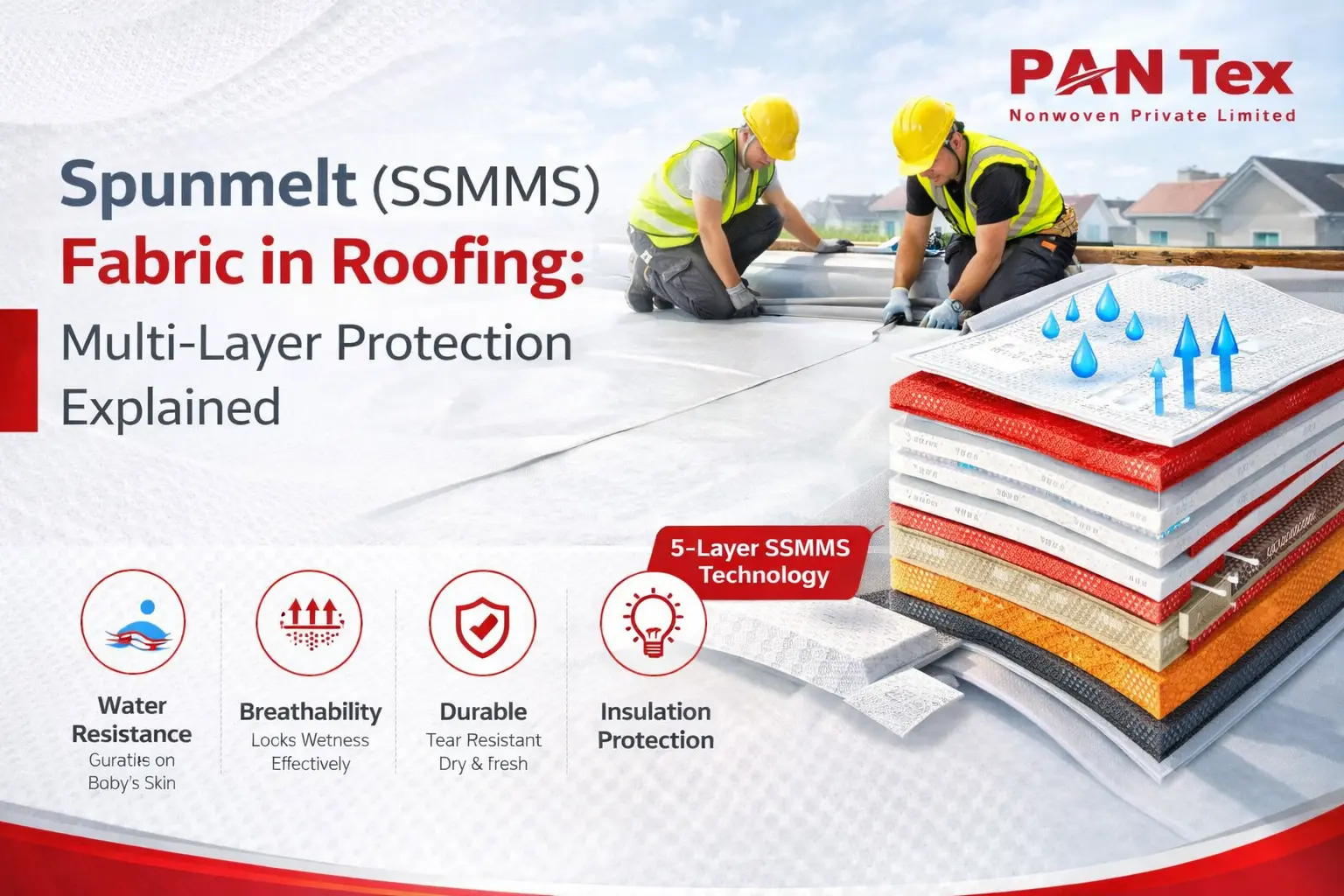
SSMMS stands for Spunbond, Spunbond, Meltblown, Meltblown, Spunbond. Each letter represents one distinct fabric layer within the composite structure.
Two outer spunbond layers provide primary tensile strength and tear resistance. The second inner spunbond layer adds dimensional stability and load distribution across the full width.
The double meltblown core provides maximum liquid barrier and filtration performance. By contrast, single-layer and SMS fabrics cannot match this five-layer performance architecture under real roofing conditions.
How SSMMS Differs From SMS and Standard Spunbond in Roofing
Understanding where SSMMS roofing fabric sits relative to simpler alternatives is essential for making confident specification decisions. The performance gap between configurations is measurable and directly affects roof longevity.
Furthermore, buyers who have previously specified SMS or standard spunbond need a clear technical reason to upgrade. This section provides that argument directly.
SSMMS vs. SMS Roofing Fabric
SMS has one meltblown layer positioned between two outer spunbond layers. SSMMS adds a second spunbond layer and a second meltblown layer to the construction.
The double meltblown core in SSMMS delivers measurably higher hydrostatic head resistance than SMS in every comparable GSM range. Furthermore, the additional spunbond layer distributes mechanical load more evenly under foot traffic and wind uplift stress.
As a result, SSMMS roofing fabric consistently outperforms SMS wherever sustained water pressure or high mechanical stress are primary performance concerns.
SSMMS vs. Standard Spunbond Roofing Underlayment
Standard spunbond contains no meltblown barrier layer at all. Liquid resistance relies entirely on fiber density and total GSM weight, which creates performance limitations under sustained water pressure.
By contrast, SSMMS delivers a liquid barrier through its engineered meltblown core regardless of total GSM. On the other hand, spunbond relies on mass alone, which means heavier fabric is needed to approach the barrier performance SSMMS achieves at lower weight.
In particular, this weight advantage makes SSMMS easier to handle on rooftops without sacrificing any performance characteristics.
When to Specify SSMMS Over Simpler Alternatives
High-rainfall regions where liquid water resistance is a primary roofing performance requirement are the clearest case for the SSMMS specification.
Similarly, low-slope and flat roofing where water ponding creates prolonged hydrostatic pressure demands the double-meltblown barrier redundancy that only SSMMS provides.
Above all, premium residential and commercial projects where long-term performance is non-negotiable justify SSMMS specification across every roof type and climate zone.
The Five-Layer Architecture of SSMMS Roofing Fabric Explained
Multi-layer nonwoven roofing achieves its performance advantage through the specific engineering of each individual layer within the composite. Understanding what each layer does explains why the SSMMS configuration outperforms every simpler alternative.
PAN Tex Non Woven engineers their SSMMS spunmelt fabric roofing products with precisely controlled layer weights across all five layers. This ensures each layer delivers its designed performance function consistently across every roll produced.
Layer 1: Outer Spunbond Surface Layer
The outer spunbond layer is the first contact layer between the installation environment and the fabric interior. It provides primary tear resistance during handling, cutting, and foot traffic on the rooftop.
UV-stabilized polypropylene fibers in this layer resist degradation during the installation exposure window. Furthermore, the smooth surface allows easy sliding and positioning during installation without snagging on deck fixings or rough surfaces.
Layer 2: Inner Spunbond Structural Layer
The second spunbond layer adds dimensional stability to the full composite width. It distributes mechanical load from foot traffic and wind uplift across a wider fiber area than a single outer layer could achieve alone.
Moreover, this layer prevents the localized stress concentration that causes single-layer fabrics to tear at fastener points. Because of this, SSMMS roofing fabric maintains structural integrity under nail and staple fastening across the entire installation area.
Layers 3 and 4: Double Meltblown Barrier Core
Meltblown fibers are ultra-fine, creating a tight pore structure that physically blocks liquid water movement through the fabric thickness.
The first meltblown layer provides a primary liquid barrier across the full fabric width. The second meltblown layer adds redundancy, ensuring no liquid passes through even under sustained hydrostatic pressure.
Most notably, this double meltblown core is what gives SSMMS roofing fabric its superior hydrostatic head resistance compared to every simpler nonwoven configuration. Furthermore, the fine pore structure of each meltblown layer also contributes to the fabric’s wind-driven rain resistance performance.
Layer 5: Inner Spunbond Base Layer
The final spunbond layer provides the deck-facing surface of the installed roofing fabric. It protects the meltblown barrier core from abrasion against rough deck surfaces during installation and throughout service life.
Additionally, this base layer adds final tensile strength to the composite in the cross direction. As a result, the fabric lies flat against the deck without distortion, edge lifting, or wrinkling during and after installation.
Key Benefits of Spunmelt Fabric Roofing for Construction Projects
Specifying spunmelt fabric roofing delivers a set of performance advantages that no simpler underlayment alternative can replicate. Suppliers like PAN Tex Non Woven maintain tight production tolerances across their spunmelt fabric roofing range.
This ensures tensile strength, barrier performance, and GSM weight remain consistent from roll to roll across large-scale construction projects.
Superior Liquid Water Resistance
The double meltblown core provides measurably higher hydrostatic head resistance than any single-layer alternative at equivalent GSM. Most notably, it resists liquid penetration under sustained hydrostatic pressure from ponding water or wind-driven rain.
This is the critical performance advantage on low-slope and flat roofing, where water pooling creates prolonged pressure against the underlayment surface.
High Tensile Strength and Tear Resistance
The double outer spunbond framework resists tearing under installer foot traffic and wind uplift loads during and after installation. Moreover, isotropic fiber distribution means equal strength in all directions with no directional weak points in the finished fabric.
As a result, SSMMS roofing fabric handles the full range of mechanical stresses during rooftop installation without developing localized failures at fastener points or cut edges.
Breathability and Vapor Transmission
Despite its five-layer construction, SSMMS roofing fabric maintains controlled vapor permeability through the bonded composite structure. Furthermore, it allows moisture vapor from interior building sources to pass outward through the fabric during normal building operation.
Because of this, trapped condensation that causes structural rot and mold in roof assemblies is prevented across the full service life of the installed system.
Lightweight Performance Advantage
SSMMS achieves its multi-layer protection at significantly lower total weight than heavier single-layer alternatives, delivering equivalent performance. Similarly, easier handling on rooftops reduces installation fatigue and speeds up the laying process across large roof areas.
On the other hand, heavier single-layer fabrics require more effort to carry, position, and fasten, which increases installation time and labor cost without delivering superior performance.
UV and Weather Resistance During Installation
UV-stabilized outer spunbond layers resist degradation during extended installation exposure windows on large commercial projects. In particular, this stabilization maintains structural and barrier performance for several weeks of pre-covering exposure.
Above all, UV resistance during installation is critical on large commercial projects where staged installation extends the period before the outer covering protects the underlayment from direct sunlight.
Long Service Life and System Compatibility
Properly specified SSMMS roofing fabric lasts between 25 and 50 years within a completed roofing system. Most notably, it is compatible with asphalt shingles, metal panels, clay tiles, TPO membranes, and PVC systems without chemical incompatibility.
Consequently, synthetic polymer construction resists rot, biological growth, and chemical degradation throughout the full service life of the roofing system it supports.
Where Spunmelt Nonwoven Construction Use Applies Across Roofing Systems
Spunmelt nonwoven construction use extends across every major roofing system type in both residential and commercial sectors. PAN Tex Non Woven supplies SSMMS Spunmelt fabric roofing products across residential, commercial, green roof, and industrial applications.
Their product weights and layer configurations are matched to each system’s specific performance demands, giving specifiers a reliable product option across every project type.
Steep-Slope Residential Roofing
On steep-slope residential roofs, SSMMS underlayment is installed between the structural deck and the outer shingle or tile layer. For instance, the double meltblown barrier prevents wind-driven rain penetration through gaps in the outer covering during storm events.
In particular, this secondary barrier performance is what protects the structural deck from water damage if the primary roofing layer is compromised before repairs can be made.
Commercial Flat and Low-Slope Roofing
Flat roof water ponding creates sustained hydrostatic pressure that basic spunbond underlayments cannot reliably resist over time. Similarly, the double meltblown core of SSMMS roofing fabric handles prolonged water pressure without breakthrough.
Furthermore, SSMMS is used as a membrane carrier and reinforcement layer in TPO and PVC flat roof systems, providing dimensional stability and puncture resistance within the finished membrane assembly.
Green Roof Systems
SSMMS multi-layer nonwoven roofing acts as a root-resistant separation layer between the growing medium and the drainage aggregate in green roof assemblies. Beyond that, the double meltblown barrier resists root penetration that would otherwise compromise the waterproof membrane below.
In addition, the hydrolysis stability of polypropylene spunmelt construction ensures decades of reliable performance under the continuous moisture exposure that green roof assemblies create.
Metal Roofing Systems
Spunmelt nonwoven construction used under metal panels manages condensation on the deck-facing surface during thermal cycling. Most notably, the breathable outer spunbond layer allows vapor transmission while the meltblown core blocks liquid water movement in the reverse direction.
Additionally, this combination prevents the moisture accumulation that causes corrosion of metal fasteners and accelerated structural deck deterioration in metal roofing assemblies.
Industrial and Warehouse Roofing
Large-span industrial roofs experience extreme thermal cycling that creates repeated mechanical stress on the underlayment layer across every seasonal temperature change. Moreover, SSMMS’s dimensional stability from the double spunbond framework handles these cycles without fatigue failure over the long service periods industrial roofing requires.
Furthermore, the multi-layer construction provides an extended service life that reduces the frequency and cost of industrial re-roofing programs.
Multi-Layer Nonwoven Roofing: Understanding GSM and Layer Weight Distribution
Evaluating multi-layer nonwoven roofing fabric correctly requires more than reading the total GSM figure on a product data sheet. Layer weight distribution across all five layers determines performance in a way that total GSM alone cannot reveal.
Understanding this distinction is what separates informed specifiers from buyers who compare products on total weight alone.
What GSM Means in a Multi-Layer Nonwoven Roofing Context
GSM stands for grams per square meter and measures total fabric weight per unit area. In multi-layer nonwoven roofing, this total weight is distributed across five individual layers with different performance functions.
A fabric with a higher meltblown layer weight delivers superior barrier performance at equivalent total GSM compared to one where spunbond layers carry most of the weight. Specifically, always request a layer-by-layer weight breakdown rather than total GSM alone from any SSMMS supplier.
Recommended GSM Ranges for SSMMS Roofing Applications
Residential steep-slope roofing typically requires 80 to 150 GSM total, which provides adequate barrier and tensile performance for standard pitched roof applications.
Commercial flat and low-slope roofing generally requires 150 to 250 GSM to handle the sustained hydrostatic pressure these applications create. In particular, green roofs and industrial applications call for 200 GSM and above for maximum mechanical and barrier performance under continuous load.
How Bonding Method Affects SSMMS Roofing Fabric Performance
Thermal point bonding creates discrete bond points across the fabric surface that maintain flexibility and drape during installation. Furthermore, flat calendar bonding creates a denser, stiffer fabric with higher surface abrasion resistance.
Most SSMMS roofing fabric uses thermal point bonding for the flexibility required during rooftop installation. On the other hand, bonding pattern density directly affects fabric breathability, so always verify the bonding specification alongside the vapor permeability value.
How to Read a Technical Data Sheet for SSMMS Roofing Fabric
Selecting the right SSMMS roofing fabric requires reading and understanding the full technical data sheet before committing to any purchase. Reputable manufacturers like PAN Tex Non Woven provide a full technical data sheet for every SSMMS spunmelt fabric roofing product in their range.
This documentation covers every value a specifier needs to confirm performance suitability for their specific project type and climate zone.
Structural Performance Values to Verify
Tensile strength must be reported in Newtons per 5cm strip in both the machine direction and the cross direction separately. In particular, missing cross-direction tensile data is a common omission from lower-quality supplier documentation.
Elongation at break in both directions confirms fabric flexibility under dynamic loading from wind and thermal movement. Furthermore, the tear resistance value confirms performance under concentrated point loads from roofing fasteners during installation.
Moisture and Barrier Performance Values to Verify
Hydrostatic head resistance is the most critical barrier performance value for any SSMMS roofing fabric. It should be measured in mbar or centimeter water column and reported with a referenced independent test standard.
Water vapor permeability, expressed as an Sd value, determines breathability. Moreover, the hydrolysis resistance rating confirms that the fabric maintains its performance properties under sustained moisture exposure across the full service life.
Environmental and Durability Values to Verify
UV resistance rating in hours of exposure before measurable property loss confirms safe installation exposure duration. Additionally, the temperature resistance range confirms performance across freeze-thaw cycles in cold climates and high-heat cycles in desert environments.
That said, always confirm whether the fiber content is virgin polypropylene or a recycled or blended grade. On the other hand, recycled content without certification introduces unknown variability into performance across production batches.
Red Flags When Evaluating Any SSMMS Roofing Fabric Supplier
A supplier who cannot provide a full TDS with independent test references is the most significant warning sign in any evaluation process. However, equally concerning is a data sheet that reports total GSM without providing a layer-by-layer weight breakdown.
Missing hydrostatic head resistance data specifically means the most critical barrier performance value is unverified. In fact, any supplier who cannot confirm the meltblown layer count or individual layer weight cannot reliably deliver the SSMMS performance architecture that the product claims.
Common Specification Mistakes When Choosing Spunmelt Fabric Roofing
Even experienced roofing contractors and specification engineers make errors when selecting spunmelt fabric roofing for construction projects. Understanding the most common mistakes protects both the roof performance and the project budget.
Mistake 1: Confusing SMS with SSMMS
SMS and SSMMS share similar naming conventions but deliver fundamentally different performance levels in roofing applications. However, SMS has one meltblown layer while SSMMS has two, which doubles the liquid barrier redundancy of the composite.
That said, the naming similarity leads many buyers to assume they are evaluating equivalent products when they are not. In particular, always confirm the meltblown layer count explicitly before finalizing any nonwoven roofing fabric specification.
Mistake 2: Evaluating Total GSM Without Layer Breakdown
A high total GSM does not guarantee high barrier performance if the meltblown layers carry insufficient weight within the total. Furthermore, two products with identical total GSM can have measurably different hydrostatic head resistance values depending on how layer weight is distributed.
As a result, always request layer-by-layer weight confirmation before comparing any two SSMMS roofing fabric products on the same project specification.
Mistake 3: Under-Specifying GSM for the Application
Specifying below the recommended GSM for a flat or green roof application results in inadequate barrier performance under sustained water pressure. Because of this, the double meltblown core requires minimum layer weight to deliver its designed hydrostatic resistance performance.
Therefore, specifying below the minimum GSM for the application type negates the performance advantage of SSMMS construction entirely, regardless of the number of layers present.
Mistake 4: Purchasing Without Independent Test Certification
Supplier-reported performance values without independent test references cannot be reliably verified before purchase. In fact, independent test certification is the only documentation that confirms values on the TDS reflect real measured performance rather than theoretical design targets.
Moreover, always request test report references alongside the full TDS before finalizing any spunmelt fabric roofing purchase, particularly on high-value commercial or industrial projects.
Conclusion
Spunmelt fabric roofing in the SSMMS configuration delivers a level of multi-layer protection that no simpler underlayment alternative can match. Five distinct layers, each performing a specific function, combine to create a fabric that simultaneously handles tensile stress, liquid barrier, vapor management, and UV resistance.
The performance gap between SSMMS and simpler alternatives is not marginal. It is measurable across tensile strength, hydrostatic head resistance, and service life, all of which directly determine the long-term integrity of the roofing system above it.
Correct specification of multi-layer nonwoven roofing requires understanding layer architecture, GSM distribution, and verified technical data. Furthermore, it requires a supplier whose manufacturing consistency matches the performance promises on the data sheet.
PAN Tex Non Woven produces SSMMS spunmelt fabric roofing materials to consistent manufacturing standards, with full technical documentation available for every product in their range.
Explore the PAN Tex Non Woven SSMMS spunmelt roofing fabric range and request a technical data sheet to find the right specification for your next construction project.
Frequently Asked Questions
What is spunmelt fabric roofing used for?
Spunmelt fabric roofing is used as a high-performance underlayment layer between the structural roof deck and the outer roofing surface. In addition, it is used as a membrane reinforcement carrier, a green roof separation layer, and a condensation management layer in metal roofing systems.
What does SSMMS stand for in roofing fabric?
SSMMS stands for Spunbond, Spunbond, Meltblown, Meltblown, Spunbond. Furthermore, each letter represents one distinct functional layer within the five-layer composite fabric architecture.
How does SSMMS roofing fabric differ from SMS?
SMS contains one meltblown barrier layer between two outer spunbond layers. By contrast, SSMMS adds a second spunbond layer and a second meltblown layer, delivering significantly higher hydrostatic head resistance and tensile strength at equivalent total GSM.
What is the best GSM for SSMMS spunmelt roofing underlayment?
The correct GSM depends on the application type. Residential steep-slope applications typically require 80 to 150 GSM. Moreover, commercial flat and low-slope applications generally require 150 to 250 GSM for adequate sustained hydrostatic resistance.
Is SSMMS roofing fabric breathable?
Yes. Despite its five-layer construction, SSMMS roofing fabric maintains controlled vapor permeability through the bonded composite structure. However, breathability varies between products, so always verify the Sd value on the technical data sheet for the specific product being specified.
Can spunmelt nonwoven construction be used to cover flat roof applications?
Yes, and flat roofing is one of the strongest application cases for the SSMMS specification. Specifically, the double meltblown core handles the sustained hydrostatic pressure from water ponding that simpler underlayment fabrics cannot reliably resist over long service periods.
What should I check on a technical data sheet for SSMMS roofing fabric?
The key values to verify are tensile strength in both directions, hydrostatic head resistance, water vapor permeability as an Sd value, UV resistance rating, confirmed fiber type, and layer-by-layer weight breakdown. Furthermore, all values should reference an independent test standard rather than being supplier-reported only.
How long does spunmelt fabric roofing last in service?
Quality SSMMS spunmelt fabric roofing, correctly specified and installed within a complete roofing system, typically lasts between 25 and 50 years. Most notably, longevity depends on correct GSM specification for the application, UV stabilization quality, and whether the product meets roofing-grade manufacturing standards.