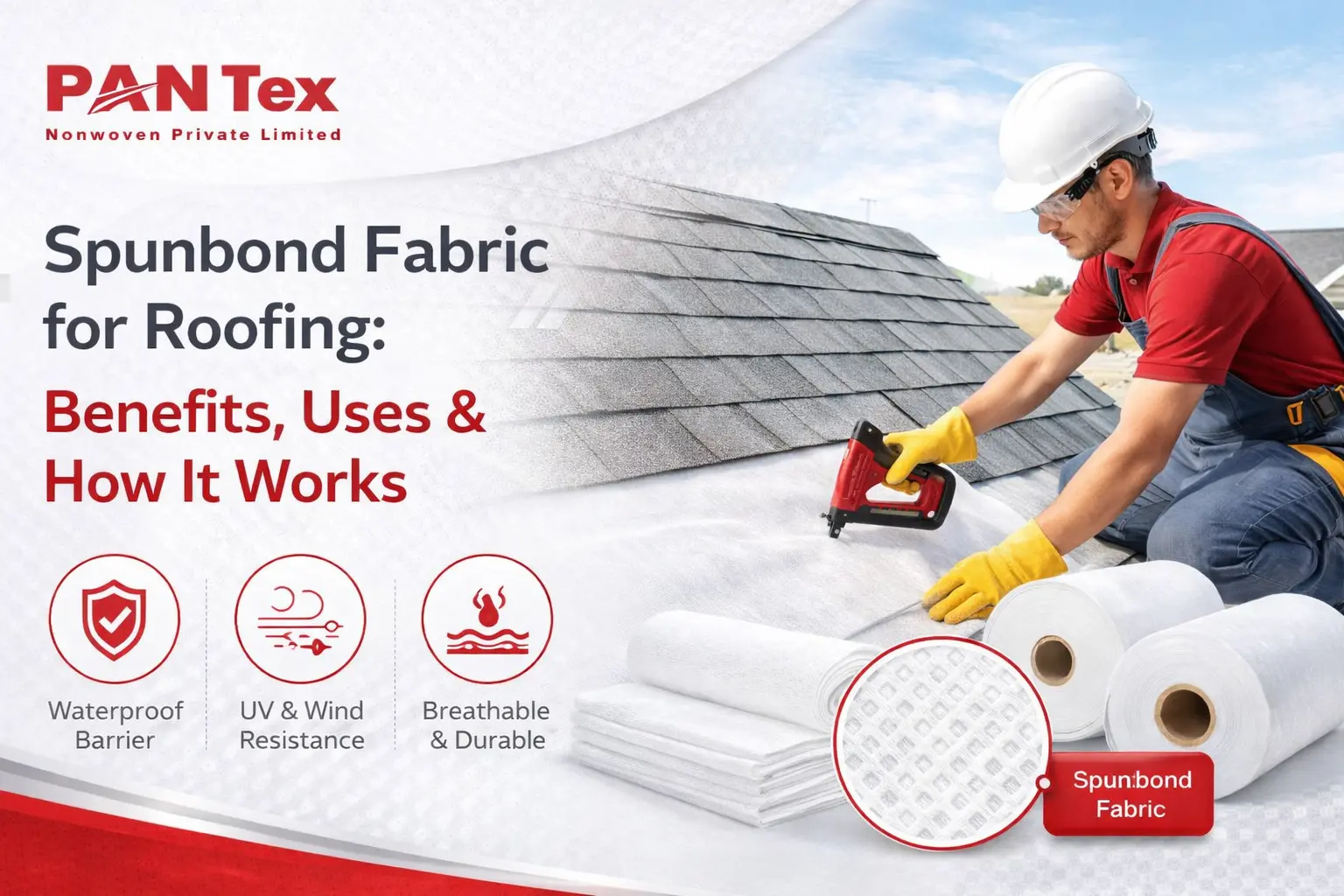
Spunbond fabric for roofing is one of the most important yet least understood components in a modern roofing system. It is an engineered nonwoven material made by bonding continuous polymer filaments together using heat and pressure.
The result is a strong, lightweight, and breathable fabric layer that sits beneath the outer roofing surface. In construction, the difference between a roof that performs reliably for 50 years and one that fails within a decade often comes down to the quality of this single underlayment layer.
Furthermore, as roofing systems become more technically demanding across residential, commercial, and industrial applications, manufacturers like PAN Tex Non Woven have built their product ranges specifically around the performance demands that modern roofing systems require.
This guide covers everything a contractor, specifier, or procurement professional needs to understand about spunbond fabric for roofing, from how it is made to how to buy it correctly.
What You Will Learn
- What spunbond fabric for roofing actually is and how it is manufactured
- Why polypropylene spunbond roofing outperforms traditional roofing felt
- The difference between standard spunbond and SSS spunbond roofing fabric
- Key applications and where spunbond nonwoven roofing underlayment fits in the build
- What technical specifications to check before purchasing
- Common mistakes buyers make and how to avoid them
What Is Spunbond Fabric for Roofing?
Spunbond fabric for roofing is a nonwoven textile produced by extruding continuous polymer filaments, laying them randomly onto a moving conveyor belt to form a web, and then bonding that web using heat and pressure rollers.
As a result, the finished material is a uniform, consistent sheet with no weave pattern and no directional weak points. Unlike traditional roofing felt, spunbond fabric derives its strength entirely from the engineered fiber structure itself.
In roofing applications specifically, this fabric functions as a protective underlayment layer, a membrane reinforcement carrier, or a drainage separator, depending on the system it is built into. Moreover, it is not a decorative or secondary material.
In many roofing assemblies, the spunbond underlayment is the last line of defense between the structural deck and water penetration if the outer roofing layer is ever compromised.
How Spunbond Fabric Is Made
The manufacturing process begins with polymer chips, typically polypropylene or polyester, which are melted and extruded through fine spinnerets into continuous filaments.
These filaments are drawn out under controlled air pressure before being deposited randomly onto a moving belt, forming a loose web of fibers. Furthermore, the randomness of fiber deposition is what gives spunbond fabric its isotropic strength, meaning the material resists force equally in all directions.
The web then passes through heated calendar rollers that bond the fibers together at their contact points through thermal fusion. As a result, no adhesives, binders, or chemical agents are needed, which keeps the finished product clean, consistent, and chemically stable for roofing use.
Spunbond vs. Other Nonwoven Roofing Fabrics
Understanding where spunbond sits among the broader family of nonwoven roofing materials helps buyers make more informed specification decisions.
Needle-punched nonwoven fabric, by contrast, uses barbed needles to mechanically interlock fibers without heat, producing a thicker, denser material with excellent compression resistance but significantly higher weight.
Meltblown fabric, on the other hand, creates ultra-fine fibers using high-velocity air, giving it outstanding filtration properties but relatively low tensile strength. This makes it better suited as a middle composite layer than a standalone roofing material.
Wet-laid nonwoven uses a paper-making process and produces a smooth, dimensionally stable sheet with good asphalt compatibility. However, its tear resistance is considerably lower than spunbond, which limits its performance where mechanical stress during installation is a concern.
What Is SSS Spunbond Roofing Fabric and Why Does It Matter?
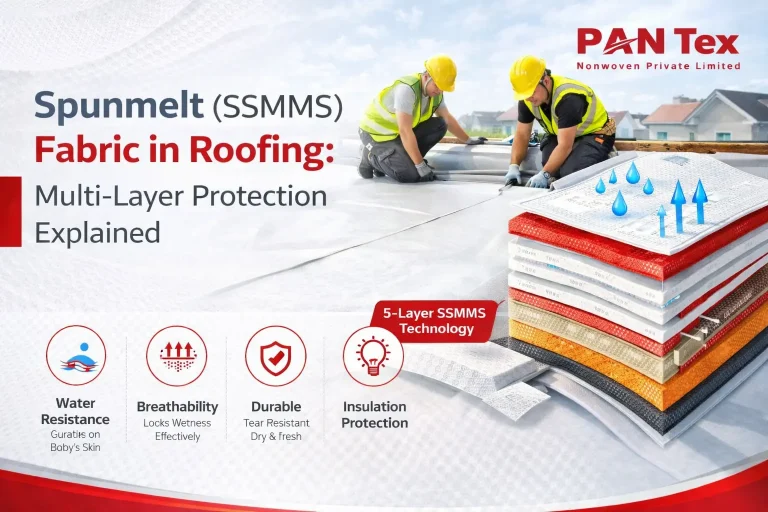
SSS spunbond roofing fabric refers to a three-layer composite structure where all three layers are spunbond nonwoven, bonded together to create a single unified sheet with significantly enhanced mechanical properties.
The outer two spunbond layers provide tensile strength, tear resistance, and surface durability. The middle spunbond layer adds dimensional stability and uniform thickness across the full width of the roll.
In particular, this three-layer architecture addresses one of the primary weaknesses of single-layer spunbond, which is its susceptibility to localized stress concentration under repeated load cycles.
PAN Tex Non Woven manufactures SSS spunbond roofing fabric in a range of weights designed to meet the demands of both residential and commercial roofing systems. This gives specifiers a consistent and well-documented product option across all application types.
Furthermore, SSS spunbond roofing fabric achieves its enhanced performance without the weight penalty that comes with needle-punched alternatives. As a result, it installs faster, handles more easily on steep rooftops, and adds less dead load to the structural deck.
Where SSS Spunbond Roofing Fabric Is Used
The three-layer structure of SSS spunbond roofing fabric makes it particularly well-suited to applications where standard single-layer spunbond would be pushed beyond its performance limits.
Most notably, steep-slope residential roofing is one of its most common applications. The fabric must resist tearing under installer foot traffic while managing wind-driven rain during the installation window before outer shingles or tiles are placed.
In addition, commercial flat roof membrane reinforcement demands the dimensional stability and consistent thickness that SSS construction delivers across large roof areas.
Beyond that, green roof systems use SSS spunbond as a separation and drainage layer because the multi-layer structure resists root penetration and compression from growing media weight more reliably than single-layer alternatives.
SSS vs. SMS: Understanding the Difference
A common point of confusion among buyers is the difference between SSS and SMS nonwoven composites.
SMS stands for Spunbond-Meltblown-Spunbond and uses a meltblown middle layer specifically engineered for fine particle filtration and liquid repellence. By contrast, SSS replaces that meltblown layer with a third spunbond layer, trading filtration capability for tensile strength and tear resistance.
However, roofing applications rarely require the fine filtration properties of meltblown fabric. As a result, SSS spunbond roofing fabric is the preferred specification for most construction roofing uses, where structural performance under mechanical stress matters far more than filtration efficiency.
Key Benefits of Spunbond Nonwoven Roofing Underlayment
Choosing the right underlayment is not simply a compliance decision. In fact, spunbond nonwoven roofing underlayment delivers a specific set of performance advantages that directly affect the long-term integrity of the entire roofing system above it.
Superior Tensile Strength in All Directions
Because spunbond fabric is produced by randomly depositing continuous filaments across the full web width, the finished material has no preferred direction of strength.
Furthermore, this isotropic property means the fabric resists tearing equally whether the force is applied along the length of the roll, across its width, or at any diagonal angle.
In practical roofing terms, this means the underlayment handles the multi-directional stresses of installer foot traffic, wind uplift, and repeated thermal expansion cycles without developing localized weak points.
Suppliers like PAN Tex Non Woven maintain tight production tolerances to ensure tensile strength remains consistent from roll to roll across an entire roofing project. This matters significantly on large commercial and residential developments where dozens of rolls are installed across the same roof surface.
Breathability and Moisture Vapor Management
One of the most critical performance requirements of any roofing underlayment is its ability to allow water vapor to pass outward through the fabric while blocking liquid water from entering from above.
Moreover, this balance between breathability and waterproofing is what prevents the buildup of trapped condensation inside the roof assembly.
Because of this, spunbond nonwoven roofing underlayment is engineered with a controlled pore structure that permits vapor transmission while the continuous bonded fiber web prevents liquid water from passing through under normal hydrostatic pressure.
When an underlayment is impermeable, moisture that enters the roof assembly from interior sources cannot escape. This leads to rot, mold growth, and eventual structural failure of the deck and rafters below.
Lightweight and Easy Installation
Spunbond fabric achieves high tensile strength and tear resistance at a significantly lower weight than needle-punched or woven alternatives. As a result, rolls of spunbond nonwoven roofing underlayment are easier to carry up ladders, position across large roof areas, and cut without specialist tools.
Additionally, the wide roll formats available from manufacturers like PAN Tex Non Woven reduce the number of lap joints needed across a roof surface. This both speeds installation and reduces the number of potential weak points in the finished underlayment layer.
Cut edges in spunbond fabric do not fray or unravel the way woven materials do. This further reduces on-site waste and handling care needed during installation in windy conditions.
UV and Weather Resistance
During the window between underlayment installation and outer roofing placement, the spunbond fabric is exposed directly to sunlight, rain, wind, and temperature extremes.
Similarly, in applications where the fabric remains partially exposed at edges or penetrations, ongoing UV resistance matters for the service life of the system.
UV-stabilized polypropylene spunbond roofing fabric incorporates stabilizing additives during the extrusion process that slow the degradation of polymer chains under ultraviolet radiation.
In particular, this stabilization allows a quality spunbond underlayment to remain on an exposed roof deck for several weeks during a staged installation without losing structural integrity before the outer covering is applied.
Long Service Life and Broad Compatibility
Above all, the value of spunbond nonwoven roofing underlayment is its longevity once installed within a finished roofing system.
Properly specified and installed fabric from a quality manufacturer lasts between 20 and 50 years in service, matching or exceeding the expected lifespan of the outer roofing materials it supports.
Most notably, spunbond fabric is compatible with the full range of modern roofing surface materials, including asphalt shingles, clay and concrete tiles, standing seam metal panels, and TPO or PVC membranes, without chemical incompatibility or adhesion issues.
Its synthetic polymer construction means it does not absorb water, support biological growth, or degrade through the rotting process that limits the service life of organic felt underlayments.
Polypropylene Spunbond Roofing: Why Polypropylene Is the Preferred Fiber
Polypropylene spunbond roofing fabric dominates the market for a straightforward set of material reasons. Polypropylene is inherently hydrophobic, meaning it does not absorb water at the fiber level.
This makes it naturally resistant to the moisture-related degradation that affects other fiber types over time. Furthermore, its chemical resistance is broad, covering the alkaline and acidic environments that roofing materials and weather exposure create.
PAN Tex Non Woven produces polypropylene spunbond roofing fabric across a range of GSM specifications, making their product line adaptable from lightweight residential underlayment applications through to heavy-duty commercial and infrastructure roofing projects.
The cost efficiency of polypropylene as a raw material also means that high-performance polypropylene spunbond roofing fabric can be specified at significantly lower cost per square meter than polyester alternatives of comparable weight.
Polypropylene vs. Polyester Spunbond for Roofing
Both polypropylene and polyester are used in spunbond roofing fabric production, but they serve different application profiles. The table below summarizes the key differences to guide specification decisions.
| Property | Polypropylene Spunbond | Polyester Spunbond |
| Weight | Lighter | Heavier |
| UV resistance | Good with stabilizers | Excellent naturally |
| Cost | Lower | Higher |
| Hydrolysis resistance | Excellent | Good |
| Hydrophobic nature | Inherently hydrophobic | Less hydrophobic |
| Best application | General underlayment | High-UV or bituminous systems |
On the other hand, polyester spunbond offers naturally superior UV resistance without requiring stabilizer additives. This makes it the preferred choice for bituminous membrane reinforcement and extreme UV environments.
However, for the majority of residential and commercial roofing underlayment applications, polypropylene spunbond delivers the performance required at a lower material cost and lighter installation weight.
What GSM Means and How to Choose the Right Weight
GSM stands for grams per square meter and is the standard measure of fabric weight used across the nonwoven industry. Specifically, a higher GSM indicates a heavier, denser fabric with greater mechanical strength and tear resistance.
In particular, residential steep-slope roofing underlayment typically calls for a GSM range of 9 to 100. This provides adequate tensile strength and moisture management without adding unnecessary weight to the roof structure.
Commercial flat and low-slope roofing systems generally require 9 to 100 GSM to handle the compression loads from foot traffic, rooftop equipment, and water ponding.
As a result, always confirm the GSM specification against the specific roof type, slope, climate, and expected load before purchasing any spunbond roofing fabric product.
Where Spunbond Fabric for Roofing Is Used in Real Applications
Spunbond fabric for roofing is not a single-purpose material. PAN Tex Non Woven supplies spunbond fabric for roofing applications across residential, commercial, green roof, and industrial sectors, with product specifications matched to each application’s unique demands.
Understanding how the fabric performs across these different contexts helps contractors and specifiers select the correct product weight and construction type for each project.
Residential Steep-Slope Roofing Underlayment
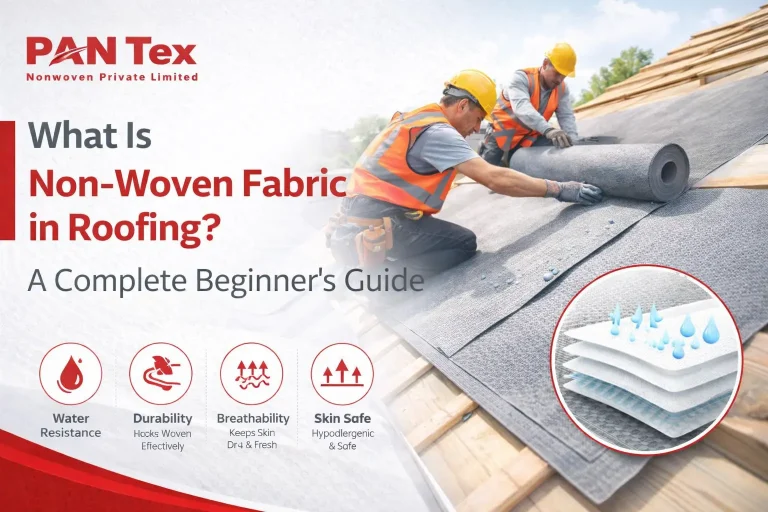
In steep-slope residential roofing, spunbond nonwoven underlayment is installed directly onto the structural deck before the outer shingles, tiles, or metal panels are fixed in place.
For instance, on a standard pitched timber-frame roof, a 100 GSM polypropylene spunbond fabric provides the secondary water barrier that prevents rain infiltration through any gaps or blow-offs in the outer shingle layer.
In particular, the breathability of quality spunbond underlayment is critical here. It allows the timber deck to dry out naturally if moisture does penetrate, rather than trapping it and accelerating rot.
Commercial Flat and Low-Slope Roofing Systems
Commercial flat roofing places significantly greater demands on underlayment materials than residential steep-slope applications.
Similarly, the compression loads from rooftop mechanical equipment, maintenance foot traffic, and water ponding require heavier SSS spunbond roofing fabric in the 9 to 100 GSM range. This maintains structural integrity over the full service life of the system.
Furthermore, in TPO and PVC single-ply membrane systems, spunbond fabric is laminated directly to the underside of the membrane during manufacturing. This provides dimensional stability, puncture resistance, and an installation slip plane that allows the membrane to move under thermal expansion without tearing at fastener points.
Green Roof Systems
Green roof assemblies use spunbond nonwoven roofing underlayment as a critical separation layer between the growing medium and the drainage aggregate below.
Beyond that, the fabric must allow water to pass downward through it freely while preventing fine soil and organic particles from migrating into the drainage layer. Without this separation, the drainage layer clogs, and the growing medium above becomes waterlogged.
In addition, the spunbond layer in a green roof application must resist root penetration from the vegetation growing above it. This requires both sufficient fabric density and hydrolysis stability to maintain performance across years of continuous moisture exposure.
Metal Roofing Anti-Condensation Layer
Metal roofing panels, particularly in agricultural, industrial, and warehouse applications, are prone to condensation forming on their internal surfaces when warm, moist interior air contacts the cold metal.
Most notably, a spunbond nonwoven fabric bonded to the underside of the metal panel during manufacturing absorbs these condensation droplets before they can fall onto stored goods, equipment, or the building structure below.
Additionally, the fabric holds the absorbed moisture in suspension until rising temperatures cause it to evaporate and vent naturally. This makes it a passive and maintenance-free condensation management solution that requires no additional system components.
How to Read a Technical Data Sheet for Spunbond Roofing Fabric
Selecting the right spunbond fabric for roofing requires more than reading the product name and the GSM. Reputable manufacturers like PAN Tex Non Woven provide a full technical data sheet for every product in their range.
This documentation covers all the values a specifier needs to confirm suitability before committing to a purchase. Understanding how to read and interpret those values is what separates a well-specified roofing project from one that fails prematurely.
Key Values to Check on Any TDS
The most important values to verify on a technical data sheet for spunbond roofing fabric are listed below.
Tensile strength should be reported in Newtons per 5cm strip in both the machine direction and the cross direction separately. A fabric that is strong in one direction and weak in the other will develop predictable failure lines under real roofing loads.
In particular, the cross-direction tensile strength is the value most commonly omitted by lower-quality suppliers. Always request it explicitly before confirming a purchase.
Elongation at break measures how far the fabric stretches before tearing and indicates how the material will behave under dynamic loading from wind or thermal movement.
Furthermore, hydrostatic head resistance measures the water pressure that the fabric can withstand before liquid penetrates through it. Water vapor permeability, expressed as an Sd value, determines breathability. Specifically, a lower Sd value means the fabric is more breathable and allows faster vapor transmission.
Red Flags When Buying Spunbond Roofing Fabric
Not all suppliers in the spunbond roofing fabric market operate to the same documentation and quality standards.
That said, several warning signs should prompt buyers to look elsewhere. A supplier who cannot provide a full technical data sheet on request is the most significant red flag, because no responsible specification decision can be made without documented performance values.
However, equally concerning is a data sheet that reports GSM weight without reference to an independent test standard. Self-reported weights are frequently higher than the actual measured weight of the delivered rolls.
On the other hand, missing UV resistance data is a common omission on lower-grade products. If a supplier cannot confirm the fiber type used in production, the consistency and long-term performance of the product cannot be reliably predicted.
Common Mistakes Buyers Make When Choosing Spunbond Roofing Fabric
Even experienced roofing contractors and procurement professionals make specification errors when selecting spunbond roofing fabric. Understanding the most common mistakes protects both the quality of the finished roof and the financial efficiency of the project.
Mistake 1: Choosing on Price Alone
The lowest-cost spunbond fabric for roofing available in any market almost always uses recycled or blended fiber content with less consistent physical properties than virgin polymer products.
However, the cost savings at the point of purchase are typically small compared to the cost of remediation if the underlayment fails during its service life.
That said, price is a legitimate factor in specification decisions. The solution is to compare products on a cost-per-performance basis using verified technical data sheet values rather than price per roll alone.
Mistake 2: Ignoring GSM for the Specific Application
Under-specifying fabric weight for a flat or low-slope roof is one of the most common and costly errors in commercial roofing projects.
On the other hand, over-specifying GSM on a residential steep-slope application adds unnecessary material cost and increases roll weight and handling difficulty on site without a meaningful performance benefit.
As a result, always start the specification process by identifying the roof type, slope, expected load, and climate before selecting a GSM rating, rather than defaulting to a single product across all project types.
Mistake 3: Using General-Purpose Nonwoven Fabric in Roofing
Agricultural, horticultural, packaging, and medical nonwoven fabrics are manufactured to entirely different performance standards than roofing-grade spunbond materials.
In fact, many general-purpose nonwoven products use no UV stabilization at all, because their intended applications never involve prolonged sunlight exposure.
Because of this, using off-specification nonwoven fabric in a roofing application typically results in rapid UV degradation during the installation window, followed by early physical failure of the underlayment layer well before the outer roofing materials reach the halfway point of their expected service life.
Mistake 4: Overlooking Vapor Permeability
A spunbond underlayment that is impermeable to water vapor may appear to offer superior waterproofing, but it creates a moisture trap inside the roof assembly that causes far more damage than it prevents.
Therefore, always confirm the Sd value of any spunbond nonwoven roofing underlayment before specifying it for a project in a climate with significant seasonal temperature variation.
Consequently, the standard recommendation for breathable underlayment in cold and mixed climates is an Sd value below 0.1 metres, which allows rapid vapor transmission while maintaining adequate liquid water resistance for normal roofing applications.
Conclusion
Spunbond fabric for roofing is far more than a commodity underlayment material. In fact, it is one of the most technically sophisticated components in a modern roofing system.
The performance gap between a correctly specified product and a poorly chosen one is measured in decades of service life. Understanding what spunbond nonwoven roofing underlayment is, how SSS spunbond roofing fabric differs from simpler alternatives, and why polypropylene spunbond roofing fabric dominates the market gives buyers and specifiers the knowledge they need to make confident decisions.
Whether the application is a residential steep-slope, a commercial flat roof, a green roof system, or an industrial metal panel installation, matching the fabric specification to the demands of the project is the most important decision in the selection process.
PAN Tex Non Woven offers a comprehensive range of spunbond fabric for roofing, backed by full technical documentation and consistent manufacturing quality across every product in their line. Explore their product range and request a technical data sheet to find the right specification for your next roofing project.
FAQ’s for spunbond fabric for roofing
What is spunbond fabric for roofing used for?
Spunbond fabric for roofing is used primarily as an underlayment layer between the structural roof deck and the outer roofing surface. In addition, it is used as a membrane reinforcement carrier in TPO and PVC systems, a separation and drainage layer in green roof assemblies, and an anti-condensation backing on metal roofing panels.
What is the difference between SSS spunbond roofing fabric and standard spunbond?
SSS spunbond roofing fabric is a three-layer composite where all three layers are spunbond nonwoven bonded together. Furthermore, this produces higher tensile strength, better dimensional stability, and greater tear resistance than a single-layer spunbond product of equivalent GSM.
Is polypropylene spunbond roofing fabric breathable?
Yes. Polypropylene spunbond roofing fabric is breathable by nature of its porous fiber web structure, which allows water vapor to pass through while blocking liquid water under normal hydrostatic pressure. However, breathability varies between products, so always verify the Sd value on the technical data sheet for the specific product being specified.
What GSM should spunbond nonwoven roofing underlayment be for residential projects?
For most residential steep-slope roofing applications, spunbond nonwoven roofing underlayment in the 100 GSM provides the right balance of tensile strength, breathability, and installation weight. In particular, heavier weights above 100 GSM are generally reserved for commercial flat roofing and high-load applications.
How long does spunbond roofing fabric last?
Quality spunbond fabric for roofing, when correctly specified and installed within a complete roofing system, typically lasts between 20 and 50 years in service. Most notably, longevity depends on correct GSM selection, UV stabilization quality, and whether the product was manufactured to roofing-grade standards.
Can spunbond fabric be used on flat roofs?
Yes, but the correct specification for flat roofing requires heavier SSS spunbond roofing fabric in the 9 to 100 GSM range. Flat roofs impose compression loads from foot traffic, equipment, and water ponding that lighter spunbond grades cannot reliably resist over a 20 to 50 year service life.
What should I check on a technical data sheet before buying?
The six key values to verify are tensile strength in both machine and cross directions, elongation at break, hydrostatic head resistance, water vapor permeability as an Sd value, UV resistance rating, and confirmed GSM weight from independent testing. Specifically, any supplier who cannot provide all six values should be approached with significant caution before purchase.