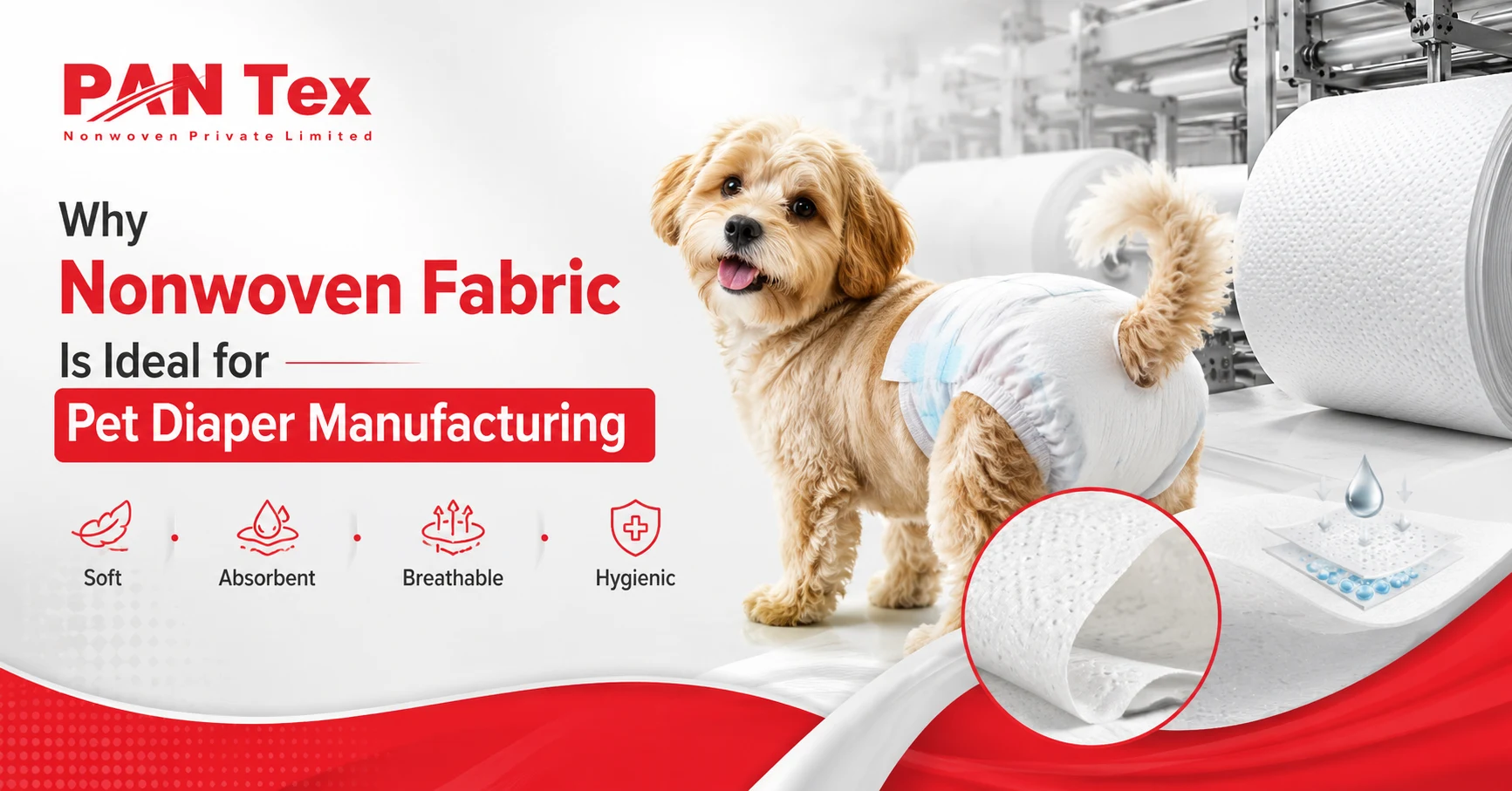
Pet diaper manufacturing is growing rapidly across the USA, UK, and European markets. Pet humanization is driving owners to demand hygiene products that match human-grade quality standards.
Furthermore, the fabric choice inside that diaper determines whether a pet stays comfortable and dry. Poor material selection causes skin irritation, fur matting, and diaper rash during wear.
Most notably, nonwoven fabric is the only material type that meets every performance requirement of a modern pet diaper simultaneously. Manufacturers like PAN Tex Non Woven supply hydrophilic and hydrophobic nonwoven fabrics specifically engineered for the softness, absorbency, and pet hygiene performance demands that premium pet diaper construction requires.
What You Will Learn
- Why is nonwoven fabric the preferred raw material for pet diaper manufacturing globally
- How does hydrophilic nonwoven work at the top sheet layer for pet hygiene performance
- Why is a hydrophobic nonwoven essential at the leg cuff, waistband, and backsheet
- What nonwoven fabric types, including spunbond, SMS, and SSMMS, suit the pet diaper layer
- How botanical specialty nonwoven adds a premium dimension to pet care products.
- What certifications and specifications should be verified when sourcing pet diaper nonwoven fabric?
What Is a Pet Diaper and Why Is Material Selection Critical?
A pet diaper is a disposable hygiene product designed for incontinent dogs, cats in heat, post-surgical animals, and elderly pets. Furthermore, the market for these products is growing consistently across the USA, UK, and European pet care sectors.
Most notably, the fabric inside the diaper directly determines whether a pet experiences comfort or discomfort. As a result, material selection is the most critical decision in any pet diaper manufacturing program.
The Growing Market for Pet Diapers
Pet humanization is the dominant market force driving premium pet care product demand. Owners now expect their pets to receive hygiene products matching human standards.
Furthermore, aging pet populations are growing as veterinary care extends lifespans. As a result, the demand for reliable, comfortable pet diapers is increasing year on year across all major global markets.
Premium pet diaper products command higher retail margins. However, they require verified material quality at every layer to justify both the price point and the performance promise.
Why Fabric Choice Determines Pet Diaper Performance
Poor fabric choice at any layer creates failures that immediately impact the pet wearing the product. Moreover, incorrect material placement causes leakage, skin breakdown, or discomfort during normal animal movement.
Most notably, animal skin and fur have specific requirements that general-purpose fabrics simply cannot meet. In particular, the fabric must transfer fluid rapidly away from the skin while maintaining a dry and soft contact surface throughout extended wear.
Furthermore, active animals, including dogs and cats, move in ways that create dynamic stress on every seam and edge. Because of this, the containment zones of any pet diaper require a completely different fabric type from the skin contact layers.
Why Nonwoven Fabric Is the Correct Choice for Pet Diaper Manufacturing
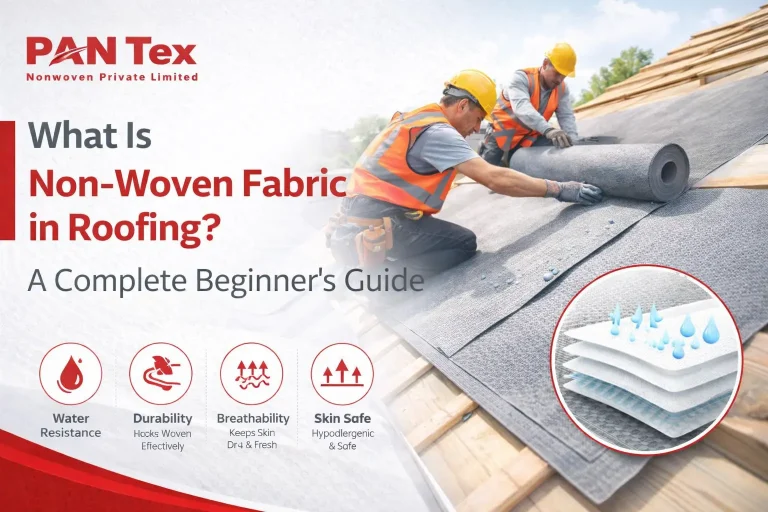
Nonwoven fabric addresses every specific demand of pet diaper manufacturing in a single material family. Furthermore, no other material type simultaneously delivers softness, controlled fluid management, leak containment, and breathability within the weight constraints of a disposable hygiene product.
Softness and Skin Safety for Animal Skin Contact
Animal skin and fur require the same softness and safety standards as human infant skin contact materials. Furthermore, nonwoven spunbond delivers a smooth, fiber-shedding-free surface completely safe for extended animal skin contact.
No rough seams, fraying edges, or loose fiber shedding risks arise at any cut edge. In particular, this non-fraying characteristic significantly reduces processing waste and handling time during pet diaper assembly lines.
Controlled Fluid Management for Pet Hygiene
Pet hygiene requires rapid fluid transfer away from the skin contact surface immediately upon absorption. Hydrophilic nonwoven top sheet moves fluid downward into the absorbent core within seconds of contact.
As a result, animal skin remains in contact with a dry surface rather than absorbing waste throughout the wear period. Because of this, the risk of diaper rash, fur matting, and bacterial skin infection is reduced significantly.
Leak Containment for Active Animals
Pet diapers experience far greater mechanical stress than baby diapers during normal animal movement. Dogs and cats move, jump, roll, and stretch in ways that create constant dynamic gaps at leg and waist edges.
Furthermore, hydrophobic nonwoven at these critical containment zones prevents fluid escape through movement-created gaps. Most notably, no woven or traditional textile alternative provides the same combination of softness and active leak containment.
Lightweight and Conforming to Animal Body Shapes
Animal bodies vary dramatically in shape between different breeds, sizes, and species. Lightweight nonwoven fabric conforms to body contours without bunching, stiffening, or restricting natural movement during wear.
Similarly, wide roll production formats allow manufacturers to cut precise custom shapes efficiently. As a result, nonwoven reduces material waste significantly during high-volume pet diaper production compared to heavier alternatives.
Cost Efficiency for High-Volume Pet Care Manufacturing
Nonwoven fabric achieves required performance specifications at a lower raw material cost than woven alternatives. Furthermore, non-fraying cut edges reduce both waste and processing time during pet diaper assembly.
On the other hand, premium nonwoven from certified manufacturers delivers consistent quality from the first batch to the last. Most notably, this consistency eliminates the costly production line adjustments that variable-quality materials create during high-volume runs.
The Correct Nonwoven Fabric for Each Layer of a Pet Diaper
Understanding which nonwoven type belongs at which layer position is the most technically critical knowledge in pet diaper manufacturing. Furthermore, the most common and costly manufacturing error is placing hydrophobic fabric at the top sheet position or hydrophilic fabric at the containment zones.
Each layer requires a specific nonwoven surface chemistry. As a result, getting the layer specification wrong creates fundamental product failure regardless of how well every other component is specified.
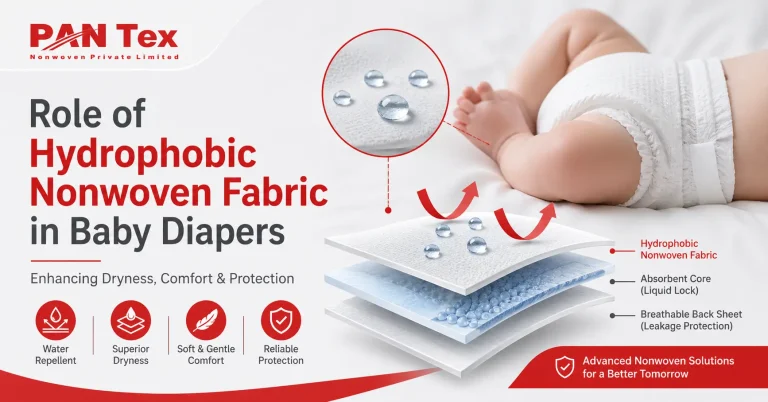
Layer 1: Hydrophilic Spunbond Top Sheet (Skin and Fur Contact Layer)
The top sheet is in direct and continuous contact with animal skin and fur throughout every wear period. Hydrophilic spunbond allows fluid to pass rapidly downward into the absorbent core below immediately upon contact.
Furthermore, the dry residual surface prevents prolonged moisture contact that causes fur matting and skin irritation. Most notably, the top sheet must always be hydrophilic nonwoven – using hydrophobic material here would prevent fluid entry entirely and cause immediate product failure.
PAN Tex Non Woven produces hydrophilic spunbond SSS nonwoven in a range of GSM weights specifically suited for pet diaper top sheet applications. Furthermore, these fabrics deliver rapid fluid transfer and a soft, dry residual surface that protects animal skin during extended wear.
In particular, the fiber-shedding-free surface of quality hydrophilic spunbond prevents any physical irritation against sensitive animal skin during movement and changing. As a result, it is the most important single-layer specification in any premium pet diaper construction.
Layer 2: Acquisition and Distribution Layer (Hydrophilic)
This layer sits directly beneath the top sheet and receives fluid passed through from above. Hydrophilic nonwoven in this position spreads liquid laterally across the full surface area of the absorbent core below.
Moreover, preventing core saturation in a single zone reduces the risk of leakage during active animal movement. Additionally, even fluid distribution across the core maximizes the total absorbent capacity available during the wear period.
Because of this, the acquisition and distribution layer directly determines how efficiently the absorbent core performs throughout its full capacity. As a result, under-specifying this layer creates premature leakage even when the core itself is not fully saturated.
Layer 3: Absorbent Core (Superabsorbent Polymer with Nonwoven Carrier)
Superabsorbent polymer bonded to a nonwoven carrier converts absorbed fluid into a stable gel form that cannot escape. Furthermore, gel conversion prevents any fluid from being released back toward the skin contact surface under body pressure.
High core capacity allows extended pet diaper wear without breakthrough during overnight or travel use. Most notably, the nonwoven carrier within the core maintains the structural integrity of the gel under the full body weight of the animal throughout the wear period.
In addition, the nonwoven carrier prevents the gel from clustering unevenly across the core during movement. Consequently, consistent gel distribution means consistent dryness performance across the entire top sheet surface throughout wear.
Layer 4: Hydrophobic Leg Cuffs (Primary Lateral Containment)
Leg cuffs must be hydrophobic nonwoven to repel fluid that reaches the lateral edges during animal movement. Active animals create constant dynamic gaps between leg cuff edges and skin during normal jumping, sitting, and walking activities.
Furthermore, hydrophobic nonwoven combined with elasticated construction creates an adaptive seal that responds to movement gaps. Most notably, this combination is the only construction that reliably contains fluid in a pet diaper used by a physically active animal.
PAN Tex Non Woven supplies hydrophobic spunbond and SMS composite nonwoven materials for pet diaper leg cuff, waistband, and backsheet applications. Furthermore, hydrostatic head resistance values are verified through full technical data sheet documentation for every grade produced.
In particular, the softness of the hydrophobic nonwoven at the leg cuff position is equally critical to its barrier function. Above all, a stiff or coarse leg cuff creates pressure marks and skin irritation regardless of how well the barrier performs.
Layer 5: Hydrophobic Waistband (Back and Front Containment)
The waistband at both the front and back of any pet diaper must be hydrophobic nonwoven. During sleep and lying-down positions, fluid moves toward the waist edge without effective hydrophobic containment to stop it.
Most notably, premium pet diapers use a dedicated hydrophobic nonwoven waistband layer at both the front and back edges separately. Furthermore, this dual waistband construction is the most reliable engineering solution for overnight and extended-wear pet diaper applications.
Additionally, the waistband nonwoven must be soft enough to avoid creating pressure marks or hair loss at the waist contact zone. Because of this, the waistband specification requires both verified hydrostatic head resistance and confirmed surface softness from the supplier.
Layer 6: Hydrophobic Backsheet (Outer Liquid Barrier)
The backsheet must simultaneously block liquid from passing outward while allowing water vapor to escape from inside the diaper. Hydrophobic nonwoven-laminated breathable film achieves both requirements within a single composite layer.
Furthermore, a soft nonwoven outer surface eliminates the plastic crinkle sound that many pet diapers produce during animal movement. As a result, pets wearing nonwoven-backsheet diapers show less stress behavior related to sound sensitivity during normal activity.
Similarly, breathable backsheet construction reduces heat and humidity buildup inside the diaper during extended wear. Most notably, this breathability directly reduces the skin temperature environment inside the diaper and the bacterial growth conditions it creates.
Nonwoven Fabric Types Used in Pet Diaper Manufacturing
The pet care industry uses several specific nonwoven fabric types across different layer positions within a pet diaper. Furthermore, understanding the differences between spunbond, SMS, SSMMS, and meltblown guides correct specification for each position.
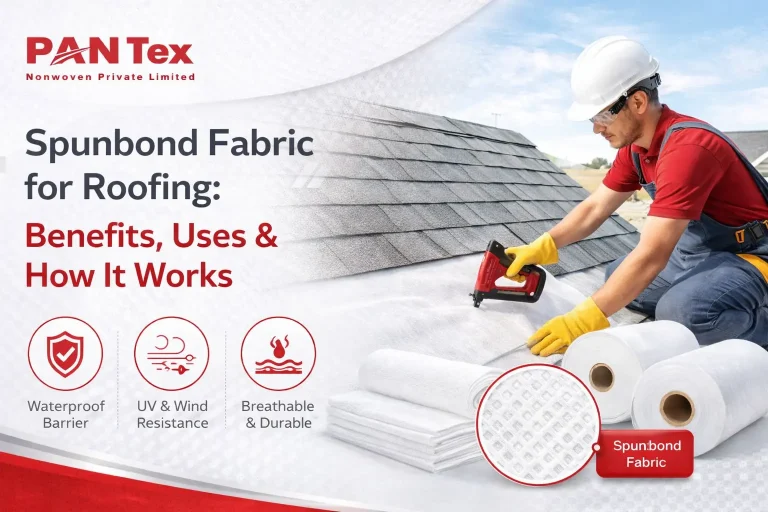
Spunbond Nonwoven (SSS) for Top Sheet and Containment
Spunbond SSS is the most widely used nonwoven type across pet diaper top sheet applications globally. Lightweight, breathable, and consistently soft against animal skin and fur, it suits the top sheet position across every pet diaper size and design.
Furthermore, hydrophilic finishing applied to spunbond creates the fluid-attracting surface that the top sheet requires. By contrast, hydrophobic finishing applied to the same base spunbond creates the fluid-repelling surface for leg cuffs and waistband applications.
In particular, the ability to produce hydrophilic and hydrophobic variants from the same base fiber type simplifies supply chain management. As a result, manufacturers can source both top sheet and containment zone materials from a single qualified nonwoven supplier.
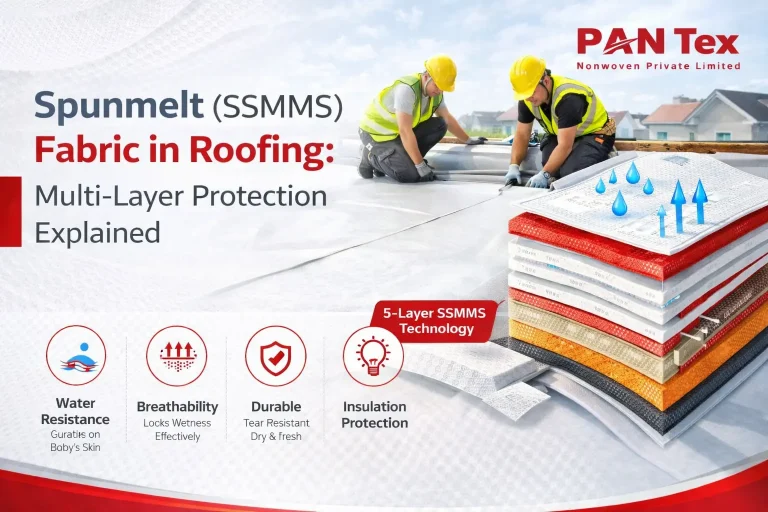
SMS and SSMMS Composite Nonwoven for Backsheet and Containment
SMS stands for Spunbond-Meltblown-Spunbond and combines a soft outer spunbond surface with a meltblown liquid barrier layer. Moreover, the meltblown middle layer provides measurably higher hydrostatic head resistance than plain hydrophobic spunbond alone.
SSMMS adds a second spunbond and second meltblown layer for superior barrier performance in the most demanding pet diaper applications. Most notably, the double meltblown core of SSMMS delivers higher hydrostatic head resistance specifically suited to large and active dog breeds.
By contrast, standard SMS suits smaller and less active animals where barrier demands are lower. As a result, matching the composite structure to the target animal size and activity level is essential for correct backsheet specification.
Meltblown Nonwoven as Barrier Middle Layer
Meltblown creates ultra-fine fiber structures that physically block liquid movement through the fabric at a microscopic level. In pet diaper applications, meltblown acts exclusively as the barrier layer within SMS and SSMMS composite structures.
Furthermore, the fine pore structure of the meltblown also contributes to odor containment within the pet diaper during wear. In particular, this odor contribution makes SMS and SSMMS backsheets significantly more effective than plain hydrophobic spunbond in premium pet care applications.
Botanical Specialty Nonwoven: The Premium Pet Care Advantage
Premium pet care brands are increasingly requiring nonwoven fabrics that go beyond basic performance properties. Furthermore, botanical extract-infused nonwoven fabrics represent the emerging frontier of premium pet diaper differentiation in competitive retail markets.
PAN Tex Non Woven produces botanical specialty nonwoven fabrics infused with Aloe Vera, Chamomile, Vitamin E, Olive Oil, and Coconut Oil. These fabrics are engineered specifically for premium pet care hygiene applications, including pet diapers, offering enhanced skin comfort and antimicrobial protection within the fabric itself.
Aloe Vera and Chamomile Infused Nonwoven for Sensitive Animal Skin
Aloe vera-infused nonwoven soothes and hydrates skin at the contact surface during extended pet diaper wear. Furthermore, this botanical treatment is applied during production rather than as a surface coating, making it integral to the fiber structure.
Chamomile-infused fabric reduces inflammation and redness for animals with known skin sensitivities or existing dermatological conditions. In particular, senior pets and post-surgical animals with compromised skin barriers benefit most from chamomile-infused top sheet nonwoven during extended wear periods.
Coconut Oil and Vitamin E for Antimicrobial Pet Hygiene Performance
Coconut oil-infused nonwoven provides natural antimicrobial properties that actively reduce bacterial growth within the pet diaper during wear. Vitamin E acts as an antioxidant that protects and repairs delicate animal skin barriers at the fabric contact surface.
Moreover, these premium botanical fabrics differentiate pet diaper products in competitive retail markets where ingredient transparency is increasingly important to pet owners. As a result, manufacturers using PAN Tex Non Woven botanical specialty fabrics can position their products at the premium tier with verified material claims.
Certifications and Standards for Pet Hygiene Nonwoven Fabric
Every nonwoven fabric used in pet hygiene product manufacturing must be produced under verified quality management and hygiene facility conditions. Furthermore, documentation of these conditions is increasingly required by premium pet diaper brands in the USA, the UK, and European markets.
PAN Tex Non Woven holds ISO 9001:2015, ISO 14001:2015, ISO 13485:2016, ISO 45001:2018, WHO-GMP, CE, and SEDEX certifications. Furthermore, materials conform to EN, AAMI, ASTM, BIS, NWSP, and EDANA standards, providing pet diaper manufacturers with fully documented compliance for every nonwoven fabric grade supplied.
Why ISO 13485:2016 Matters for Pet Hygiene Nonwoven
ISO 13485:2016 is the international quality management standard developed for medical device and hygiene material manufacturing. Pet diapers classified as hygiene products require materials manufactured under this verified quality management system.
Furthermore, ISO 13485 certification confirms that batch-to-batch consistency is maintained across high-volume production runs. In particular, this consistency eliminates the performance variation that creates weak points and leakage failures across large production batches.
WHO-GMP Compliance for Hygiene Product Manufacturing
WHO-GMP compliance confirms that the production facility meets Good Manufacturing Practice standards for hygiene and medical-grade material production. Moreover, WHO-GMP certified facilities provide documentation supporting regulatory compliance in the USA, UK, and European retail markets simultaneously.
For pet care hygiene products, facility hygiene standards directly affect the safety of materials placed against animal skin throughout extended wear. Because of this, sourcing from a WHO-GMP-compliant manufacturer is one of the most important supplier qualification criteria for any pet diaper brand.
EDANA and NWSP Standards for Nonwoven Performance Testing
EDANA and NWSP provide internationally recognized test methods for nonwoven fabric performance verification used across all major markets. Conformance to these standards ensures that tensile strength, absorbency, and GSM values are independently verified rather than self-reported.
In particular, pet diaper manufacturers sourcing from EDANA and NWSP conforming suppliers receive reliable and documented performance data for every grade. Similarly, this documentation supports product claims made on pet diaper retail packaging in regulated consumer markets.
How to Choose the Right Nonwoven Fabric for Pet Diaper Manufacturing
Selecting the correct nonwoven fabric for each layer is the most important technical decision in any pet diaper manufacturing program. PAN Tex Non Woven provides a complete technical data sheet for every nonwoven fabric grade in their pet care range.
Furthermore, this documentation covers all the values a pet diaper manufacturer needs to verify material suitability before committing to high-volume production.
Matching Nonwoven Type to Layer Position
Always specify a hydrophilic nonwoven for the top sheet and acquisition layer positions in every pet diaper design. Always specify hydrophobic nonwoven for leg cuffs, waistband, and backsheet containment positions without exception.
Furthermore, never substitute hydrophobic for hydrophilic at the top sheet position regardless of cost pressures or supplier availability. Therefore, verifying the surface treatment type on the technical data sheet before approving any material for the top sheet position is non-negotiable.
GSM Selection Guide for Pet Diaper Layers
| Pet Diaper Layer | Nonwoven Type | Recommended GSM Range |
| Top sheet | Hydrophilic spunbond | 10 to 25 GSM |
| Acquisition layer | Hydrophilic spunbond | 20 to 40 GSM |
| Leg cuffs | Hydrophobic spunbond | 15 to 30 GSM |
| Waistband | Hydrophobic spunbond | 15 to 25 GSM |
| Backsheet | Hydrophobic SMS or SSMMS | 20 to 40 GSM |
As a result, always confirm the GSM specification against the specific animal size and activity level of the target product. In particular, larger and more active dog breeds require higher GSM specifications at containment zone positions to deliver reliable leak protection.
Red Flags When Sourcing Pet Diaper Nonwoven
A supplier who cannot provide a full technical data sheet with independent test standard references is the first and most significant red flag. However, equally concerning is the GSM weight reported without independent laboratory verification from an accredited testing body.
Furthermore, the inability to confirm the surface treatment type — hydrophilic or hydrophobic, at which layer — indicates inadequate technical knowledge for pet hygiene manufacturing. On the other hand, a supplier who provides complete documentation, confirmed virgin fiber content, and hydrostatic head resistance values for all containment layers is a genuinely qualified partner.
Pet Diaper Manufacturing Trends Driving Nonwoven Demand
The global pet care market is creating consistent and growing demand for quality nonwoven materials across all pet diaper product tiers. Furthermore, several specific trends are accelerating this demand in ways that directly affect nonwoven specification requirements.
The Global Pet Care Market Is Driving Premium Diaper Demand
The global pet care market exceeded 260 billion USD in 2025 and continues growing consistently across all major economies. Pet humanization means owners in the USA, UK, and European markets now expect pet diaper products to match human hygiene product quality at every material level.
Furthermore, elderly dog and cat populations are growing as veterinary care extends pet lifespans beyond previous averages. As a result, the incontinence product segment of the pet diaper market is growing faster than any other segment.
Sustainability Requirements in Pet Hygiene Manufacturing
Biodegradable and plant-based nonwoven options are growing in demand across the USA and European pet hygiene markets. Moreover, ISO 14001:2015 environmental management certification from PAN Tex Non Woven confirms commitment to sustainable manufacturing practices throughout production.
Botanical extract nonwoven reduces the need for chemical treatments applied post-production on the finished diaper. In particular, this reduction in post-production chemical processing aligns with the clean-label ingredient transparency that premium pet care brands require for modern retail positioning.
Premium and Private-Label Pet Diaper Brands Requiring Certified Materials
Premium pet diaper brands in the USA, UK, and European markets increasingly require full supplier certification documentation before approving any material for production. Furthermore, contract manufacturers sourcing from certified suppliers significantly reduce their own regulatory compliance burden across multiple market territories.
SEDEX ethical supply chain certification from PAN Tex Non Woven supports the supplier due diligence requirements of premium pet care brands globally. Similarly, supplying materials to 80-plus brands across 40-plus export destinations confirms the trust that pet care manufacturers in major markets place in PAN Tex Non Woven material quality and consistency.
Conclusion
Pet diaper manufacturing demands a material that simultaneously delivers animal skin safety, rapid fluid management, active leak containment, and breathable outer protection. Nonwoven fabric is the only material family that achieves all four requirements within a single lightweight and cost-efficient disposable construction.
Furthermore, the correct layer-by-layer specification – hydrophilic nonwoven at the top sheet and acquisition layer, hydrophobic nonwoven at the leg cuffs, waistband, and backsheet – is the most important technical decision in any pet diaper manufacturing program. Most notably, getting this specification wrong creates fundamental product failure regardless of how well all other components perform.
Premium pet hygiene products increasingly require botanical specialty fabrics, certified manufacturing facilities, and verified technical documentation from every material supplier in the chain. In fact, these requirements are becoming standard across the USA, UK, and European retail markets rather than optional premium additions.
PAN Tex Non Woven offers a complete range of hydrophilic and hydrophobic nonwoven fabrics for pet diaper manufacturing, including botanical specialty fabrics for premium pet care applications. Furthermore, every product grade is backed by ISO certifications, WHO-GMP compliance, and full technical data sheet documentation. Request a sample or technical data sheet to start your pet hygiene product development today.
Frequently Asked Questions
What nonwoven fabric is used in pet diapers?
Hydrophilic spunbond is used for the top sheet. Hydrophobic spunbond and SMS are used for containment zones.
Is the top sheet of a pet diaper hydrophilic or hydrophobic?
Always hydrophilic. Hydrophilic nonwoven allows fluid to pass rapidly into the absorbent core below.
Why is nonwoven fabric ideal for pet diaper manufacturing?
It delivers simultaneous softness, fluid management, leak containment, and breathability within a lightweight disposable construction.
What GSM should the pet diaper nonwoven fabric be?
The top sheet uses 10 to 25 GSM. Backsheet uses 20 to 40 GSM SMS or SSMMS composite nonwoven.
What is the difference between spunbond and SMS for pet diapers?
Spunbond suits the top sheet and leg cuffs. SMS adds a meltblown barrier layer for superior backsheet performance.
Are botanical nonwoven fabrics available for pet hygiene products?
Yes. PAN Tex Non Woven produces Aloe Vera, Chamomile, Vitamin E, Olive Oil, and Coconut Oil-infused nonwoven.
What certifications should a pet diaper nonwoven supplier hold?
ISO 13485:2016, ISO 9001:2015, WHO-GMP, and conformance to EDANA and NWSP nonwoven testing standards.
Can SMS nonwoven be used for a pet diaper backsheet?
Yes. SMS provides simultaneous liquid barrier and breathability, making it the correct specification for pet diaper backsheets.
How does nonwoven fabric prevent diaper rash in pets?
The hydrophilic top sheet removes moisture from skin immediately. Breathable backsheet prevents heat and humidity buildup during wear.
What is the best nonwoven fabric for pet care manufacturing?
Hydrophilic SSS spunbond for top sheet and hydrophobic SMS or SSMMS for containment and backsheet are the correct specifications.